Play Tic-Tac-Toe Online Free
Outmaneuver computer AI or local rivals on a classic 3x3 grid.
Loading game...
About Tic-Tac-Toe
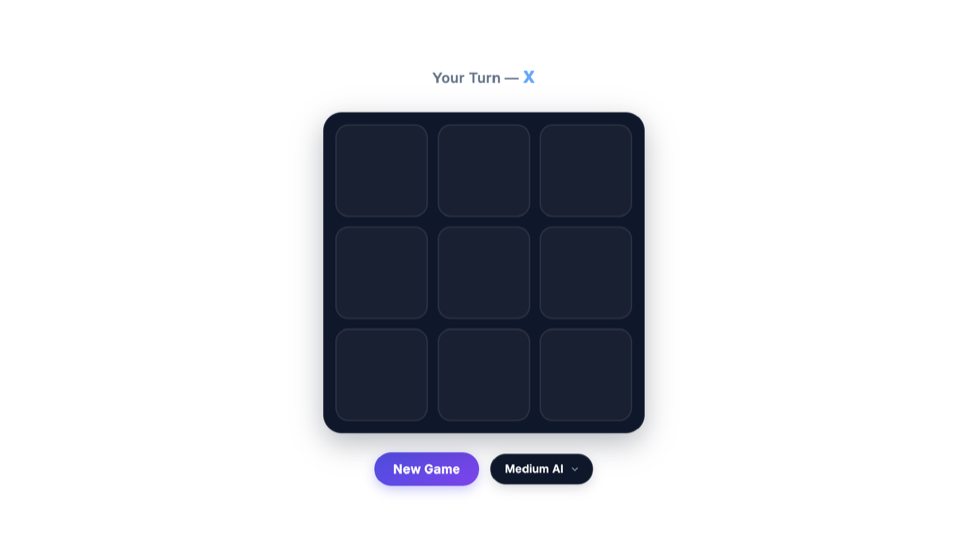
Welcome to Tic-Tac-Toe, our clean, modern adaptation of the classic paper-and-pencil game of noughts and crosses! As one of the oldest and most universally recognized strategy games in existence, it remains a true test of planning and observation. The goal is simple: alternate turns with the computer to place your X marks on the 3x3 board, aiming to align three in a row horizontally, vertically, or diagonally. Our version features three adjustable AI difficulty levels, from a casual practice mode on Easy up to a highly challenging mathematical opponent on Hard.
Every game you play updates your running session score and all-time best score, which are instantly synchronized with the stats bar at the top of the page. You can restart the board at any time using the New Game button, or switch difficulties mid-session to test your skills against the different AI behaviors. The game is fully responsive on all mobile and desktop viewports. Take your turn, plan your block strategies, and see if you can outsmart the computer!
How to Play
Select Your Difficulty
Choose between Easy, Medium, or Hard AI settings using the dropdown menu above the game board. This configures the computer's strategy engine.
Take Turns
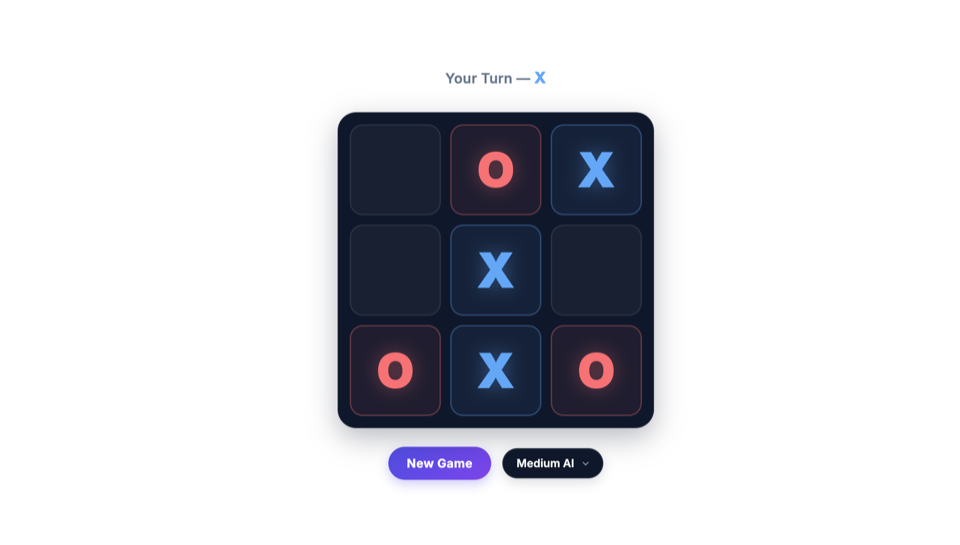
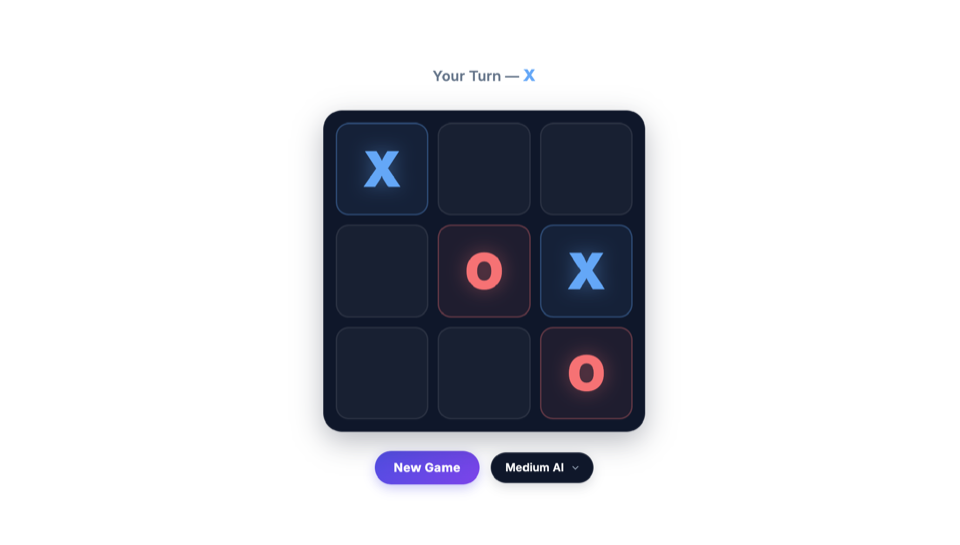
You play as X and always take the first turn. Click or tap any empty cell on the 3x3 grid to place your mark.
Block the AI
The computer will immediately play its O mark. Watch its placement carefully to block its moves and prevent it from completing a line of three.
Claim Your Points
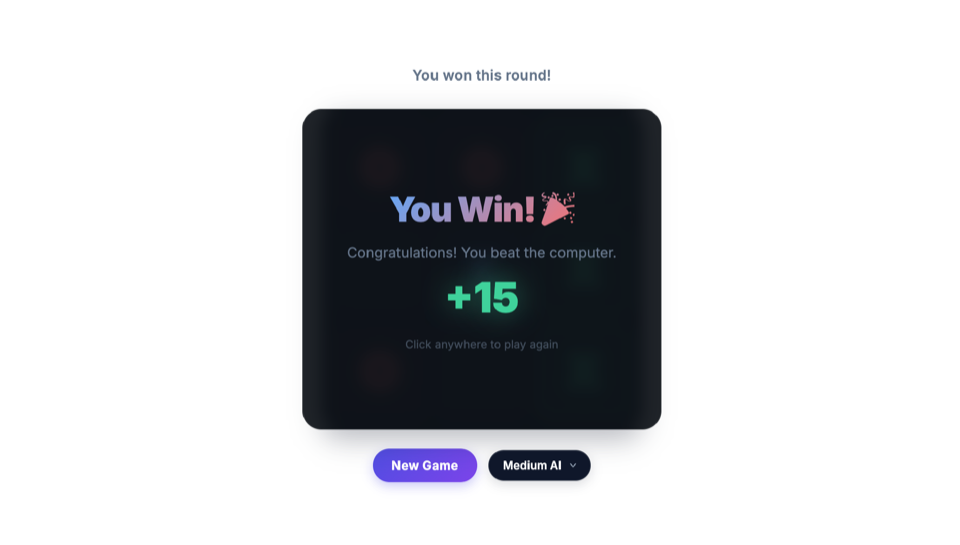
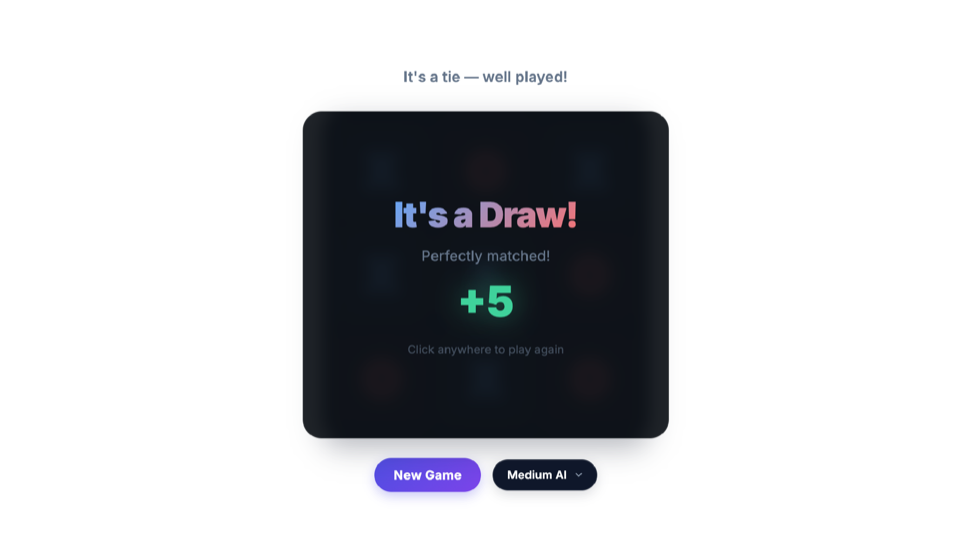
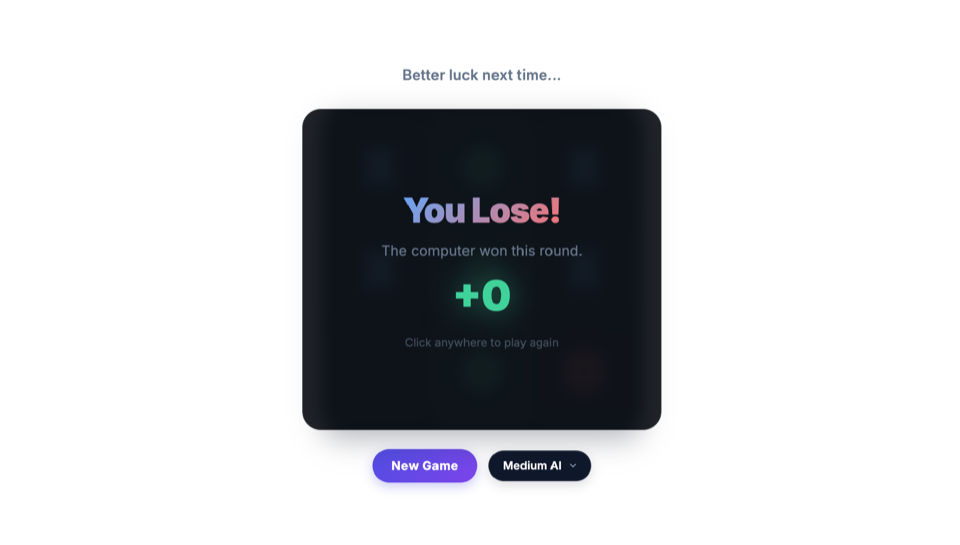
Complete a line of three to win the round and score 10 points. If the grid fills up with no winner, the game ends in a draw, awarding 5 points.
Secure the center
Always place your first mark in the center cell if it is open. This position gives you the maximum number of potential winning pathways on the grid.
Establish corner traps
Focus on taking opposing corners early in the match. Setting up two independent two-in-a-row lines guarantees a win because the computer can only block one of them.
Force defensive moves
Play offensively by creating two-in-a-row setups on your turns. This forces the computer to spend its move blocking you rather than building its own path.
Tic-Tac-Toe Player Handbook
Welcome to the official Tic-Tac-Toe mathematics player handbook and game theory guide! Whether you are playing a quick game to pass the time or testing your skills against our hardest algorithm, this manual will provide key insights into this classic grid game.
In this guide, we will trace the game's roots back to ancient empires, analyze the mathematical combinations behind the board, and unpack the minimax decision logic driving the computer's moves. Let's study the grid!
1. The Historical Journey of Noughts and Crosses
Tic-Tac-Toe is one of the oldest known strategy games in human history, with origins that can be traced back to the ancient Roman Empire. The Romans played a game called Terni Lapilli, which translates to three pebbles at a time, using boards carved into public stone surfaces.
Instead of pencil and paper, players moved three stones around a simple grid in a style similar to modern alignment games. These ancient boards can still be seen scratched into stones in historic archaeological sites throughout Europe today.
During the nineteenth century, the game became widely known in Britain as Noughts and Crosses, referencing the circular and crossing shapes of the marks. The name Tic-Tac-Toe was adopted in the United States, originally referring to a slate-writing game played by children.
In 1952, the game became a landmark in the history of computer science when researcher Sandy Douglas created OXO for the EDSAC computer. This was one of the first human-computer digital games, laying the groundwork for all modern game emulation.
Our web adaptation continues this historical lineage by offering clean digital gameplay to modern web browsers. It preserves the classic 3x3 layout while introducing adjustable strategic difficulties to test players.
2. Mathematical Combinations of the 3x3 Grid
While Tic-Tac-Toe seems simple, it actually has some very interesting math behind its classic grid. Over two hundred thousand unique paths can unfold from your very first move to the final turn.
If you ignore duplicate positions by rotating or flipping the board, there are only 765 unique layouts left. This small number makes it easy to study every possible board state and find the best moves.
In game theory, Tic-Tac-Toe is called a game of perfect information since nothing is hidden from either player. Both players can see the entire grid, meaning there is no random luck involved.
If both you and your opponent play perfectly, the game will always end in a tie. This means that as long as you do not make mistakes, you can never lose a match.
Going first gives you a slight advantage because you get to claim the center or corner spots first. Learning where to place your first mark is the key to winning more matches.
3. How the Minimax AI Algorithm Thinks
To build our challenging computer opponent, the game uses a classic decision-making system called the Minimax algorithm. This system works by looking ahead at every single move that could happen on the board.
The algorithm acts like a tree of possible moves, mapping out every choice you could make. The computer always assumes you will make the smartest move to block it.
It grades these paths by giving points for a win, losing points for a loss, and zero points for a tie. The computer then picks the move that leads to the highest score for itself.
It also tries to win as quickly as possible or delay a loss if you have a winning setup. This ensures the computer always plays smart and never lets its guard down.
This calculation happens in the blink of an eye, letting the computer react to your moves instantly. Playing against this smart system is a fun way to test your skills and practice your defense!
4. Glossary of Terms
Terni Lapilli
The ancient Roman name for early three-in-a-row alignment games. This historic game was played with physical pebbles on grids carved into public stones.
Computer Mind
The automated system that calculates the best moves during play. It anticipates your turns and chooses the path that blocks your path to victory.
Cat's Game
A popular colloquial term for a draw or tie match in Tic-Tac-Toe. This state occurs when the board is completely filled with no player achieving three in a row.
Open Playfield
A board layout where all spaces and moves are completely visible to both players. This means there are no hidden cards or lucky dice rolls to change the outcome.
Direct Contest
A type of game where one player's success is directly tied to the other player's defeat. There is no middle ground, as every point earned blocks your opponent.
Board Mirroring
The strategy of looking at the board from different angles to spot similar setups. Recognizing these repeating patterns helps you plan your moves much faster.
Fork
An advanced board layout where a player creates two simultaneous winning lines. Creating a fork guarantees victory because the opponent can only block one path.
Move Mapping
The process of planning out possible responses to your opponent's moves. Thinking several steps ahead allows you to set up forks and block traps.