Play Minesweeper Online Free
Uncover safe tiles using numerical clues while avoiding hidden hazards.
Loading game...
About Minesweeper
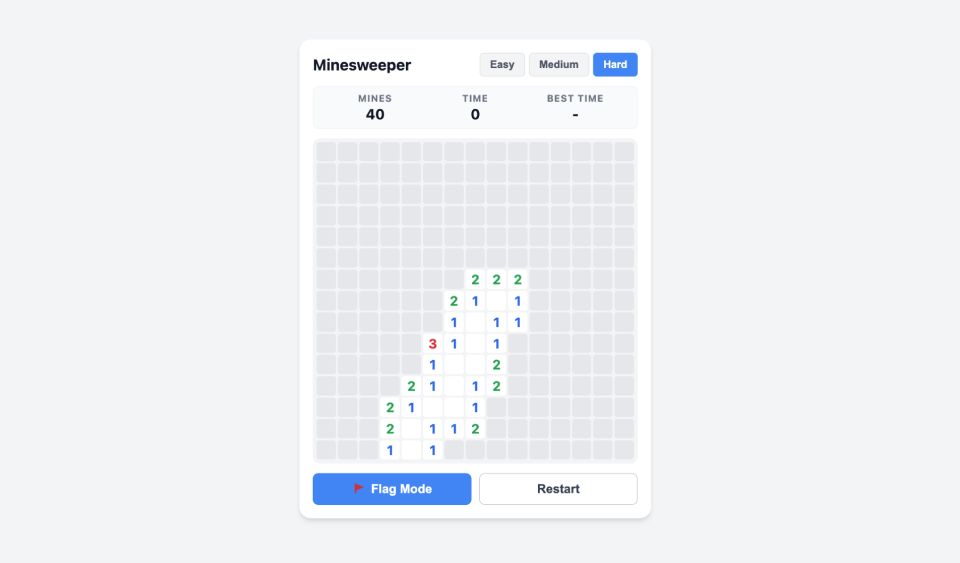
Welcome to the minefield! Minesweeper is the ultimate classic logic puzzle that has challenged minds and tested deductive reasoning for decades. The objective is simple yet deeply engaging: clear the entire grid by revealing all the safe squares without detonating any of the hidden mines. Every number you reveal is a vital clue, indicating exactly how many mines are hidden in the eight adjacent cells surrounding that number.
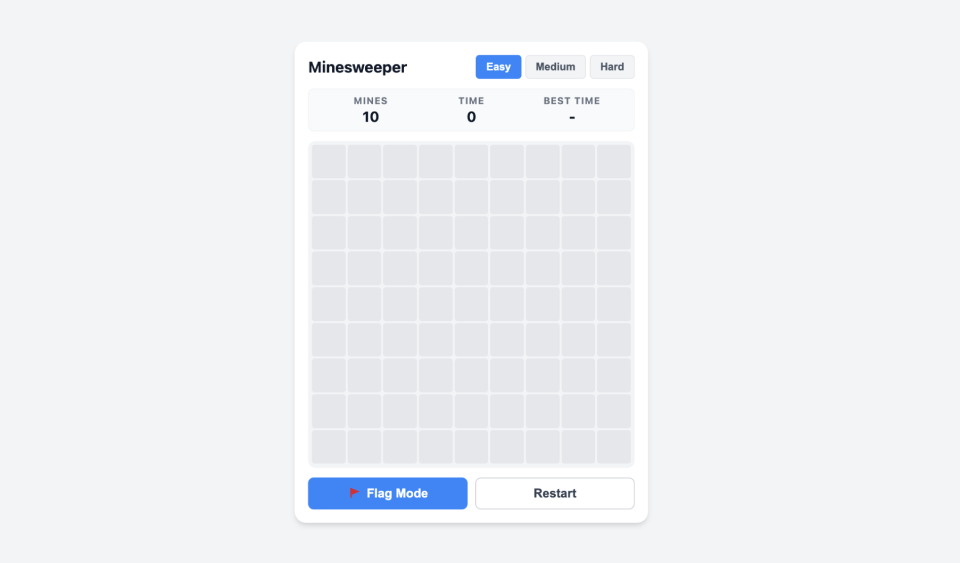
You can choose between three distinct board sizes and mine densities to match your skill level:
- Easy Mode: A friendly 9x9 grid containing 10 hidden mines, perfect for learning patterns and warming up your logic.
- Medium Mode: A balanced 12x12 grid containing 22 hidden mines, offering a solid challenge for experienced players.
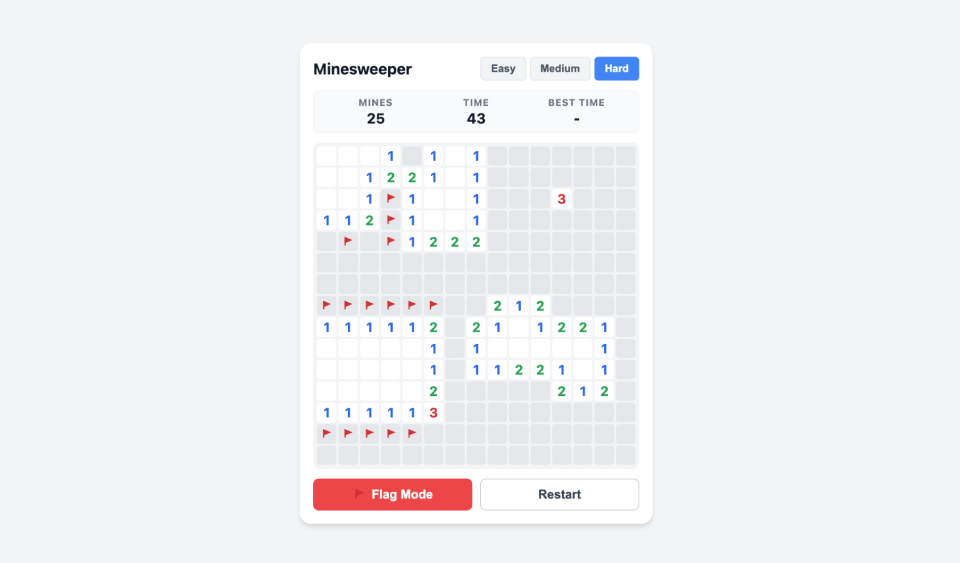
- Hard Mode: A dense 15x15 grid containing 40 hidden mines, requiring absolute precision and master-level logical deduction.
Watch your progress in real-time as your safe cells cleared count and elapsed time update live in the stats bar. Pick your grid, analyze the numbers, and let's clear the board!
How to Play
Click to Start
Select your difficulty (Easy, Medium, or Hard) and click or tap any cell on the grid to begin. Your very first click is guaranteed to be safe and will open up a starting zone.
Read the Numbers
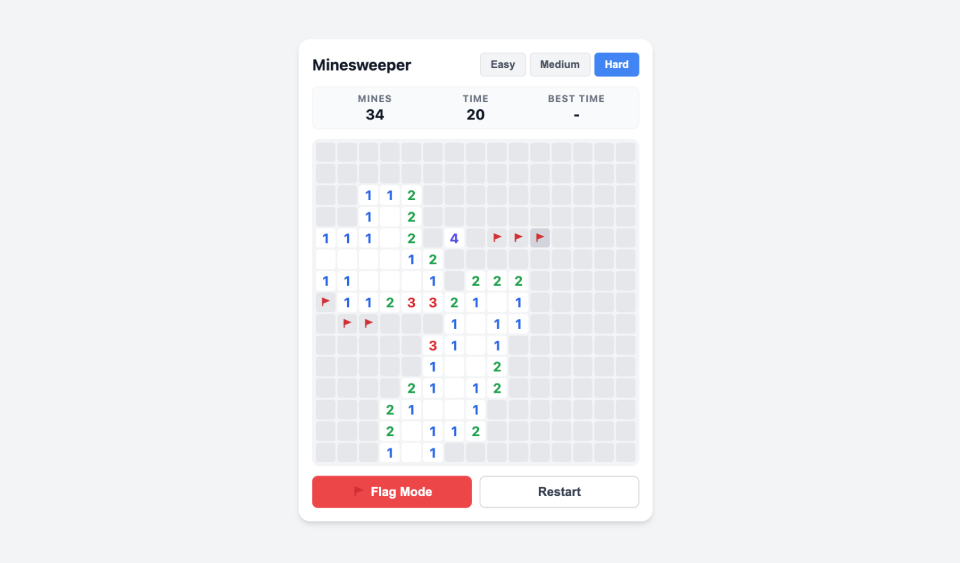
The revealed numbers indicate how many mines are hidden in the eight surrounding cells. If a cell shows a 1, there is exactly one mine touching that cell.
Flag the Mines
Use your logic to deduce which squares contain mines. Right-click (or tap the flag button on mobile/touch screens) to place a red flag on a suspected mine, preventing you from clicking it accidentally.
Clear the Board
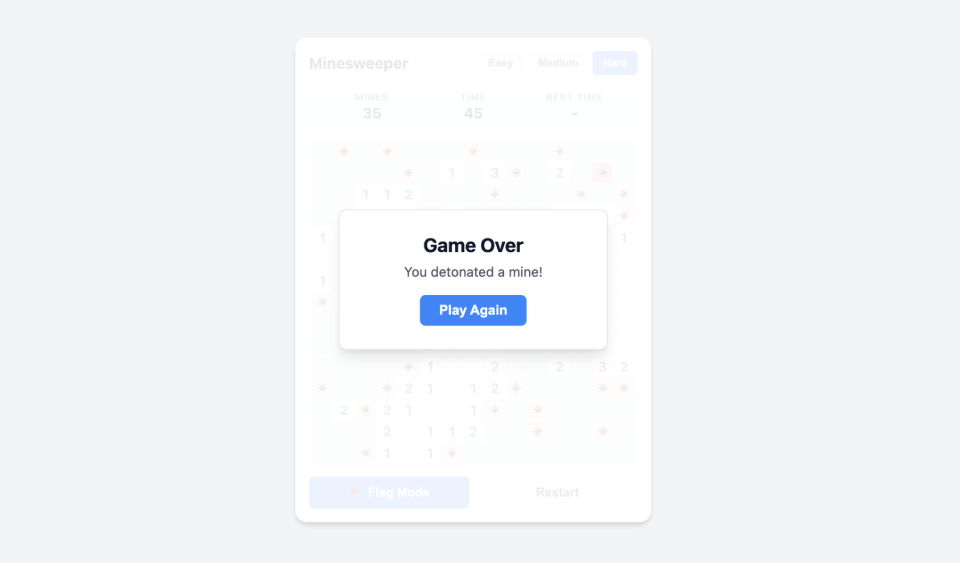
Continue revealing safe cells and flagging mines. You win the game once all safe cells are revealed, or you lose immediately if you click on a hidden mine.
Opening Zones
Start your game by clicking corner or border tiles. This increases the chance of opening up large zones and finding clear clues.
Single Matches
Look for numbers touching only one unrevealed cell. If a tile shows a 1 and has only one unopened neighbor, that neighbor is a mine.
Avoid Guesses
Focus on areas where you can make logical deductions. If a guess is required, solve other areas first to uncover helpful clues.
The Minesweeper Strategy Handbook
Welcome to the definitive strategy manual for Minesweeper, the legendary computer puzzle that has challenged minds and tested logical deduction for decades. Whether you are a casual player looking to solve your first board or an experienced logician striving to shave seconds off your Hard mode completion time, this guide is designed to sharpen your pattern recognition and eliminate guesswork.
In this handbook, we will explore the historical mainframe origins of the game, unpack the probability math and logic behind grid deduction, analyze advanced patterns like 1-2-1, and provide a clear glossary of terms to master the minefield. By learning to read numerical adjacencies and apply strategic chording shortcuts, you will transform your approach to the grid and achieve consistent victories.
1. The History of the Minefield: From Mainframes to Windows
Minesweeper's lineage goes back to the early mainframe computer games of the 1960s and 1970s, where players navigated text-based grids to find a safe path while avoiding hidden obstacles. By the 1980s, games like Minedout and Relentless Logic added numerical clues to show how many hazards were adjacent to the player's position, establishing the core deduction mechanic.
The modern version of Minesweeper was created in 1989 by Curt Johnson and Robert Donner, who originally named it Mine and released it as part of the Microsoft Entertainment Pack. Microsoft renamed it Minesweeper and included it in the standard Windows 3.1 operating system bundle in 1992, using the game to help users get comfortable with the new mouse interface.
Initially intended as a simple training utility to teach users left-clicking and right-clicking coordination, the game quickly captured the attention of puzzle enthusiasts worldwide. Over the years, Minesweeper transitioned from a standard pre-installed software utility into a global competitive sport, spawning speedrunning communities and tournaments.
2. The Mathematics of Deduction: Probability and Grid Logic
Minesweeper is much more than just a test of luck since it relies entirely on logic and basic probability. Finding the safest squares to click requires using simple clues to narrow down where the mines are hidden.
When you start, the chance of clicking a mine depends on how many mines are left versus the number of closed squares. For example, an easy board has only ten mines spread across eighty-one cells, making your first few clicks very safe.
As you clear safe squares and place flags, the local odds change to give you definite answers. If a square shows a number one and has only one unopened neighbor left, you can be completely sure that neighbor is a mine.
3. Advanced Patterns: Mastering the 1-2-1 and Chording
To clear the grid like a pro, it helps to memorize a few common number patterns that tell you exactly where to click. The most famous layout is the one-two-one pattern along flat walls, where the mines are always on the outer edges.
Another helpful sequence is the one-two-two-one layout, where the middle two squares are always mines. Learning these patterns saves you lots of time, letting you speed through the board without guessing.
Additionally, you can use a shortcut called chording to speed up your game and clear groups of cells at once. Double-clicking a number will open all its unflagged neighbors, but you must make sure your flags are correct first.
4. Glossary of Minesweeper Terms
Clue Number
The number revealed on a safe square showing how many mines are hidden in the eight surrounding spaces. This number is the key clue you use to clear the board.
Chording
A shortcut technique where clicking a number reveals all its surrounding unflagged cells. This is only possible once the correct number of flags has already been placed.
Flag
A red marker you place on a square where you think a mine is hidden. This locks the square and prevents you from accidentally clicking it.
Mine
A hidden hazard that ends your game immediately if you click it. You must find all these danger spots using logic to win the match.
Mine Density
The total number of mines spread across the board. A higher density means more danger and fewer safe spots to click.
Opening
A large cluster of blank cells that reveal themselves simultaneously on a single click. This provides multiple numerical clues to start the game.
Safe Square
Any square on the board that does not contain a mine. Your goal is to click and reveal all these safe spaces to win.
Coin Flip
A situation where you have to guess between two unopened squares with only one mine left. Sometimes logic cannot help you, and you must simply trust your luck.