Play Blackjack Online Free
Test your strategy against the dealer or challenge a friend locally.
Loading game...
About Blackjack
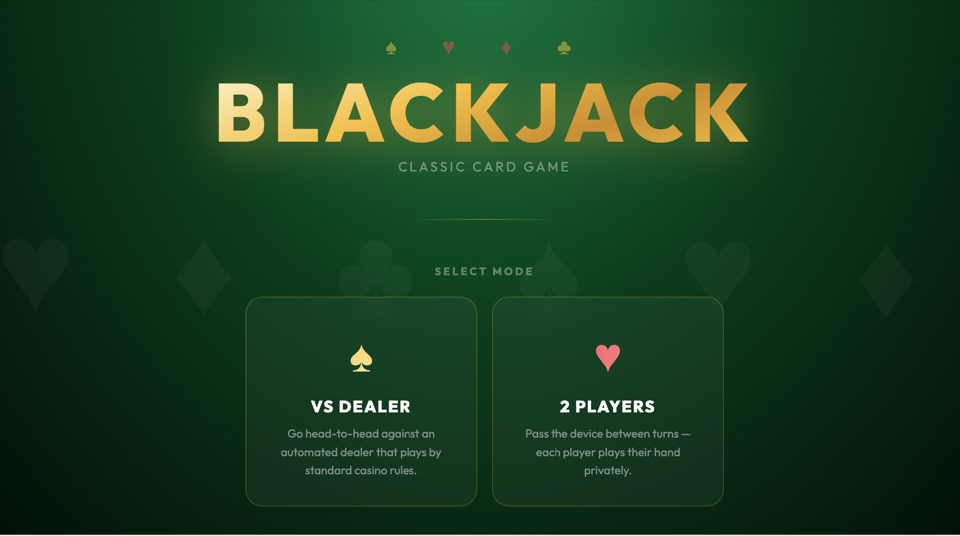
Welcome to the table! Whether you are a seasoned card shark or just looking to learn the ropes of basic strategy, you are in the perfect place. We built Blackjack to offer a clean, fast-paced, and authentic casino-style card experience. The rules follow standard casino conventions: your goal is to beat the dealer by building a hand value that gets as close to 21 as possible without crossing over it. Ace cards are dynamic, counting as either 1 or 11 depending on what fits your hand best, while face cards are worth a solid 10 points.
You can choose between two main play modes at the start screen:
- vs Dealer: Play solo against the CPU. The dealer operates under strict automated house rules, hitting on anything below 17 and standing on 17 or above.
- 2 Players: Enjoy a local pass-and-play matchup. Play with a friend on the same screen, taking turns drawing cards and competing to see who can beat the dealer's final hand.
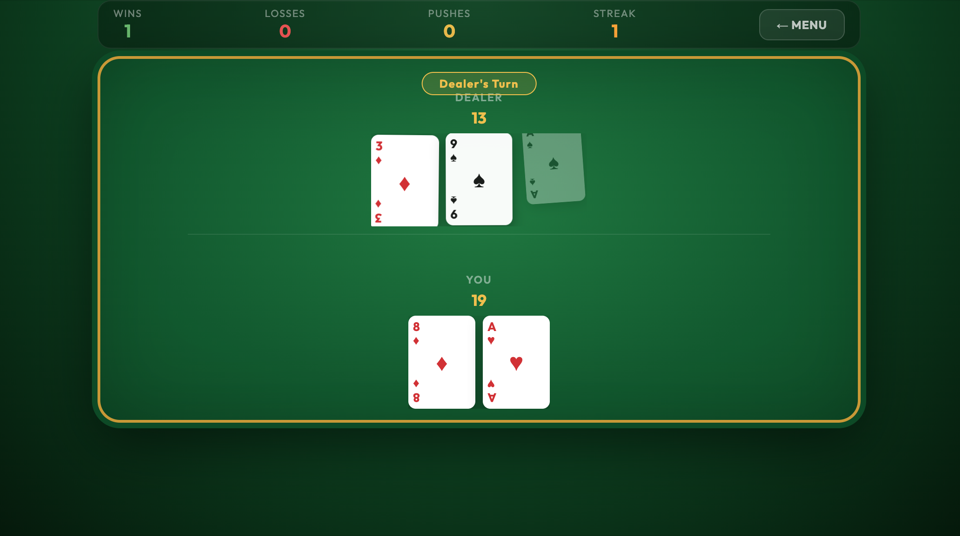
Watch your wins, losses, ties (pushes), and current win streak update in real-time in the stats bar at the top of the page. Take a seat, plan your strategy, and let's see how many hands you can win!
How to Play
Select Mode and Deal
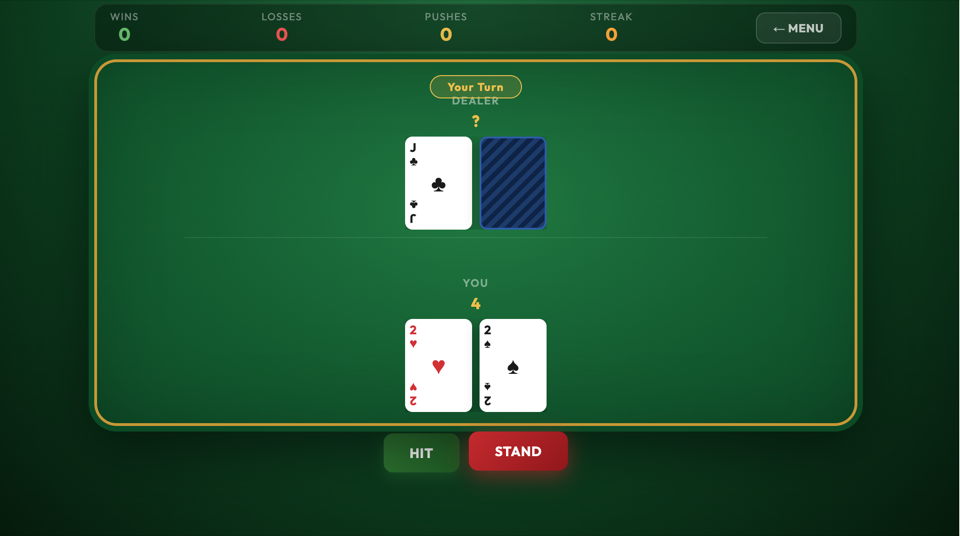
Choose vs Dealer (CPU) or 2 Player local multiplayer. Click the Deal button to draw the initial cards. Each player receives two face-up cards, while the dealer gets one face-up card and one face-down hole card.
Hit or Stand
Analyze your hand. If your score is low, click Hit to draw another card and increase your total. If you are satisfied with your score, click Stand to end your turn.
Dealer's Turn
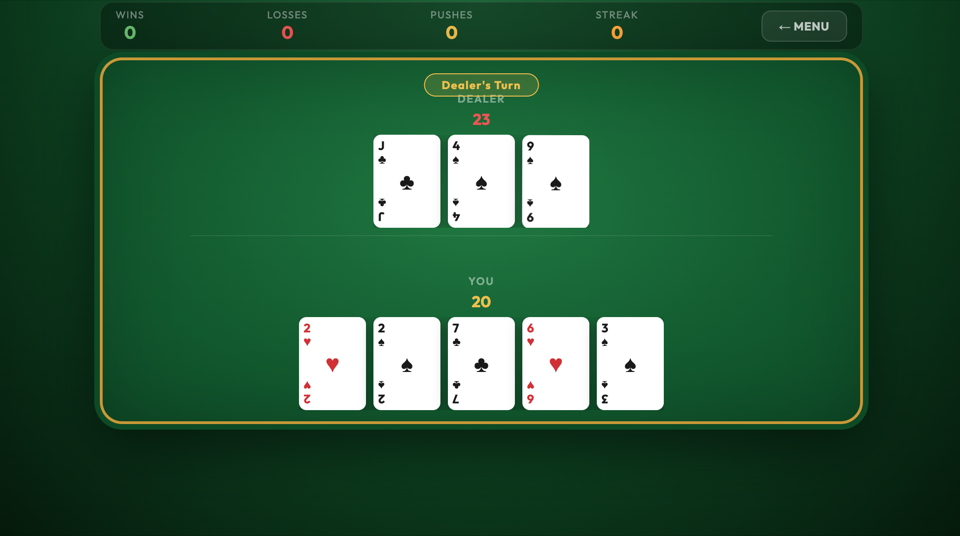
After you stand, the dealer reveals their face-down hole card. By standard rules, the dealer must hit until their cards total 17 or higher, at which point they must stand.
Win and Payouts
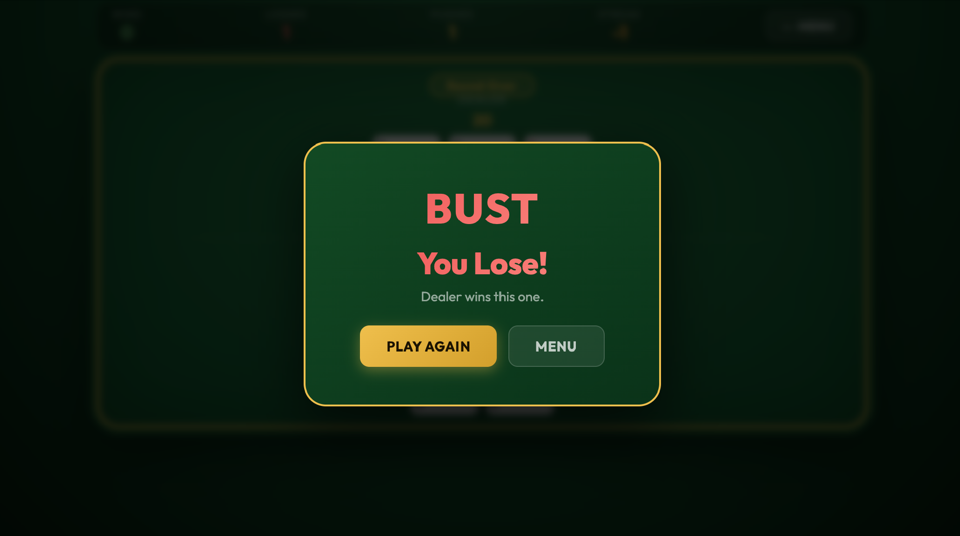
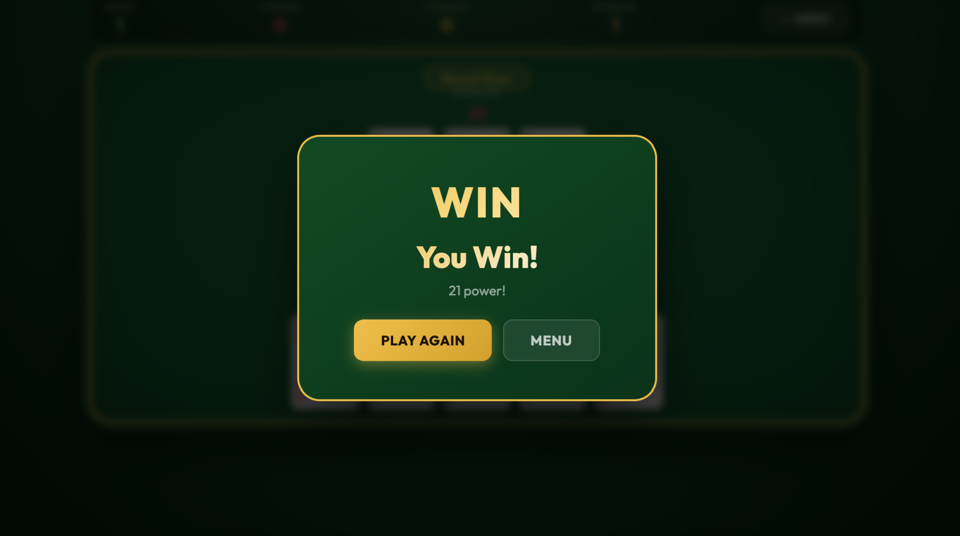
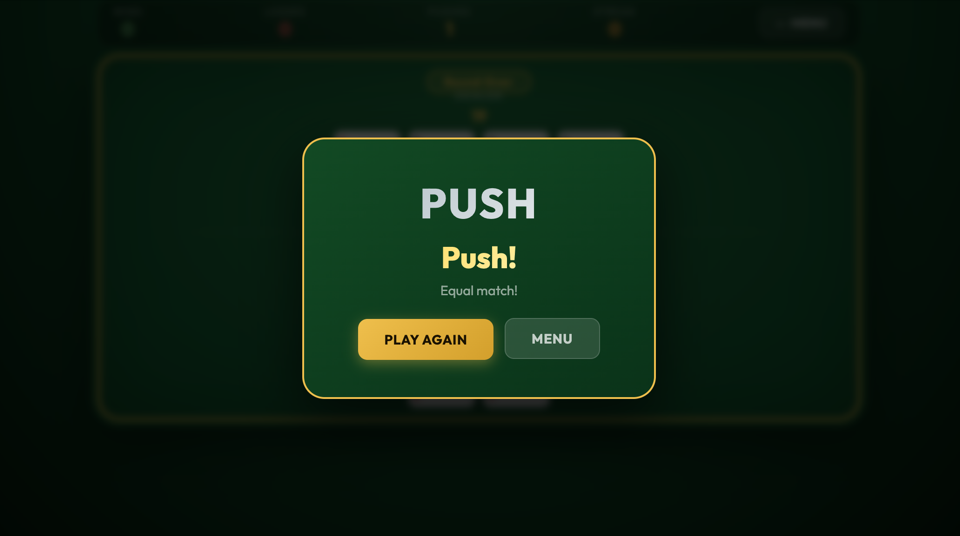
If your final hand is closer to 21 than the dealer's, or if the dealer busts (goes over 21), you win the round! If you go over 21, you bust and lose immediately. Equal totals result in a tie (push).
Bust Safety
Always hit if your hand value is 11 or lower. There is absolutely zero risk of busting, allowing you to build up your hand total.
Dealer Weakness
Pay attention to the dealer's face-up card. If they show a weak card like a 4, 5, or 6, stand and let them bust.
Soft 17 Stand
Stand on a hard 17 or above. Rushing to draw more cards at 17 is highly risky and usually leads to going bust.
Blackjack Player Handbook
This strategic guide details the history, math, and hit-or-stand tactics to help you win at Blackjack. You will learn optimal pair-splitting rules and how to read dealer card patterns.
Understanding when to take another card or stand is the secret to cutting down the dealer's natural advantage. Let's look at the basic rules and historical facts.
1. The History of Twenty-One: A Classic Card Strategy Game
Spanish author Miguel de Cervantes wrote a story about card tricks back in 1601, showing how early people loved this card challenge. Back then, the game was called veintiuna, which is Spanish for twenty-one.
As the game migrated across Europe, French players named the game Vingt-et-Un during the 1700s. Early card game enthusiasts later brought these rules across the ocean to family gatherings and social games.
To attract new players, early game hosts offered a special bonus for holding the Ace of Spades and a black Jack. While that special rule is gone today, the name Blackjack remained the official title of the game.
2. The Mathematics of Blackjack: Probability and Dealer Strategy
Unlike many card games that depend entirely on blind luck, Blackjack is a game of probability and careful decisions. Every card dealt from the deck changes the remaining cards, creating a fun puzzle for your brain.
The dealer holds a slight natural advantage at the start of a round. By following simple basic strategy rules, you can lower this advantage to less than one percent.
A smart strategy is based entirely on knowing your exact mathematical risk of going over twenty-one. For example, drawing on a twelve is relatively safe, but pulling a card on a sixteen is very risky.
3. Basic Strategy: Mastering Hits, Stands, and Splits
Basic strategy is a simple guide that shows you the best choice to make depending on the card the dealer shows. It divides your starting cards into three simple groups of hard totals, soft totals, and pairs.
A key rule of the table is to always split your pairs of Aces and Eights when they are dealt. Splitting Aces turns a weak starting twelve into two strong hands, while splitting Eights breaks up a risky sixteen.
You should never split a pair of Tens or Fives because twenty is already an excellent total. A pair of Fives gives you a solid ten, which is a perfect starting score to hit or double down.
4. Glossary of Blackjack Terms
Blackjack
A natural twenty-one achieved on the initial deal. It consists of an Ace and any ten-value card.
Bust
Going over a total hand value of twenty-one. This results in an automatic loss of your round.
Double Down
An option to double your initial score multiplier during a round. In exchange, you agree to stand after drawing exactly one additional card.
Hit
Requesting another card from the dealer to increase your hand's total. You can repeat this action until you choose to stand or bust.
Insurance
A protective side score option offered when the dealer's upcard is an Ace. This option hedges against the dealer having a natural Blackjack.
Push
A tie hand where the player and the dealer end up with the same card total. In this scenario, points remain tied.
Soft Hand
Any hand containing an Ace valued at eleven. This means the hand cannot bust upon drawing an additional card.
Stand
Electing to draw no more cards and ending your turn. This action locks in your current total to compare against the dealer.