Play Four in a Row Online Free
Drop colored tokens to line up straight streaks before your rival.
Loading game...
About Four in a Row
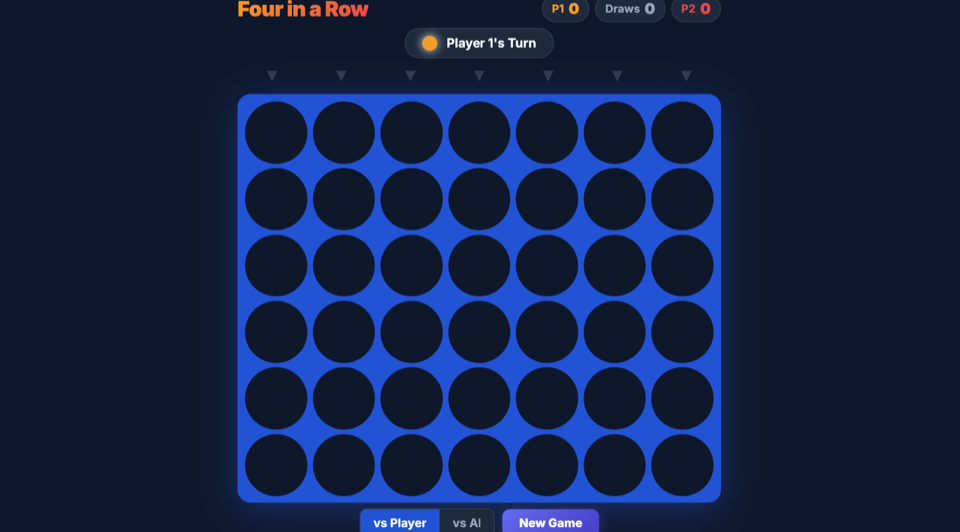
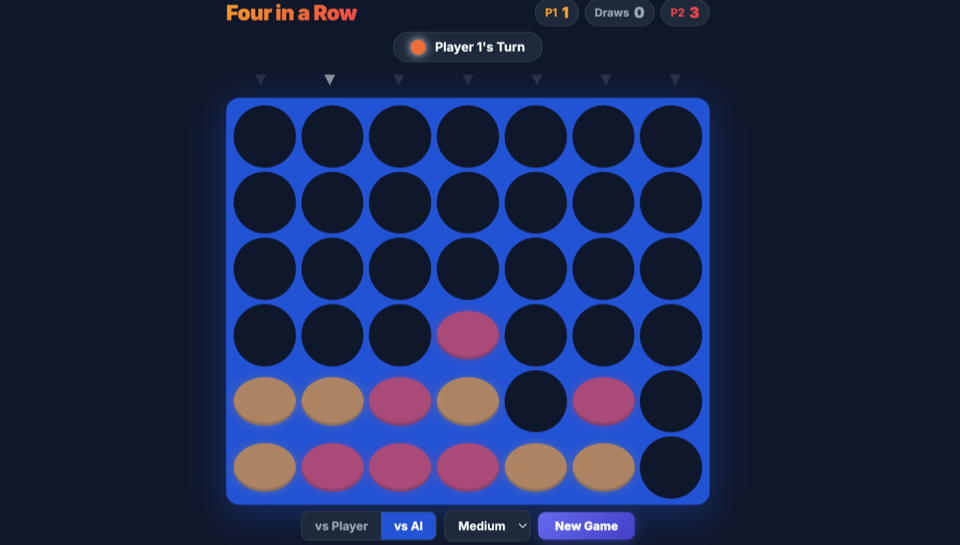
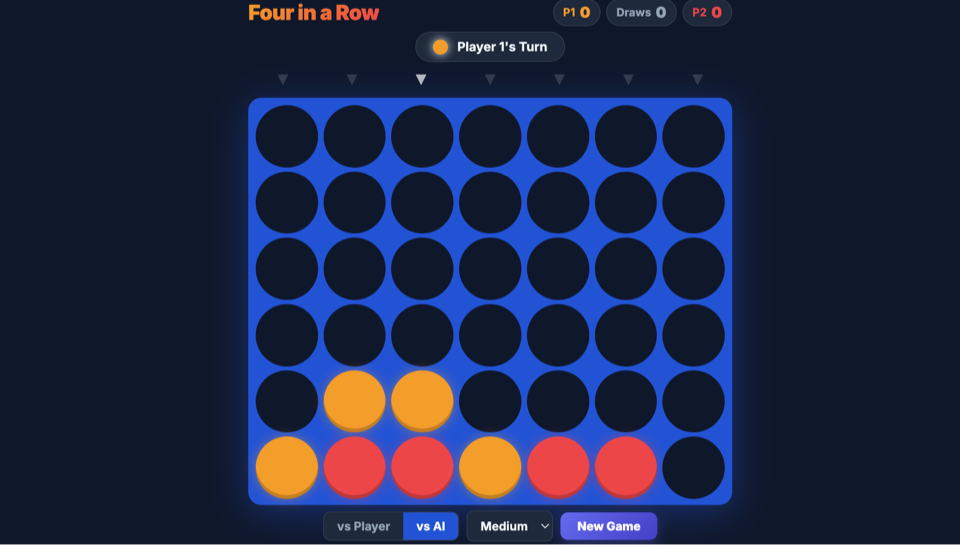
Welcome to Four in a Row, our clean web version of the classic vertical gravity-drop board game Connect Four! The goal is simple: you and your opponent alternate turns dropping colored tokens into a vertical 6x7 grid, aiming to align four of your own pieces in a straight line horizontally, vertically, or diagonally. To make the game feel true to the original tabletop version, we have overhauled the board mechanics so that every click on a column drops the token naturally to the lowest available vertical space.
This game is designed as a local two-player hot-seat challenge, allowing you to play head-to-head with a friend on the same screen. Player 1 controls the green tokens, and Player 2 controls the red tokens, with the player status banner at the top showing whose turn it is. You can easily restart the board at any time using the Restart button. Take turns, block each other's paths, and see who has the better tactical mind!


How to Play
Select a Column
Click or tap any cell in a column to select it. The game will calculate the column clicked and drop your colored token into the lowest available vertical slot.
Alternate Turns
Turns alternate back and forth. Player 1 drops a green token, then Player 2 drops a red token. The status bar at the top updates to show whose turn it is.
Block Opponent Paths
Pay close attention to the board layout. You must block your opponent from getting three in a row to prevent them from winning on their next turn.
Win the Round
Be the first to align four of your tokens in a row (horizontal, vertical, or diagonal) to win the match and score 10 points. If the board fills up with no winner, the game ends in a draw, awarding 5 points.
Control the center
Focus your opening moves on the middle column. Controlling the center gives you the most potential winning combinations across the entire board.
Watch for double threats
Build two-in-a-row lines that can be expanded on both sides. Setting up a fork where you have two winning paths makes it impossible for your opponent to block both.
Verify the row below
Before dropping a token to block your opponent, make sure you are not setting them up. Placing a token in a slot can create the base for them to drop their winning piece right above it.
Four in a Row Player Handbook
Welcome to the official Four in a Row strategy player manual and game theory strategy guide! Whether you are playing casual matches with a friend or analyzing the grid mathematically, this guide will help you understand the game rules and tactical patterns.
In this handbook, we will trace the history of the plastic vertical board design, examine the mathematical proof of perfect play, and explain column-control methods. Let's study the board!
1. The Origins of the Vertical Grid
Four in a Row was commercially released in 1974 by the toy manufacturer Milton Bradley under the famous trademark Connect Four. However, the game's core mechanics are based on much older traditional alignment games, including a historic naval game known as Captain's Mistress.
Legend says that Captain James Cook spent hours playing this vertical checker game in his cabin during long exploration voyages. The classic vertical frame design transformed traditional flat board games by utilizing physical gravity to drop tokens down columns.
The mechanical simplicity of dropping plastic checkers into vertical slots became an instant commercial hit in toy stores worldwide. The modern digital version preserves this classic vertical playfield while integrating clean browser controls.
Today, connection games are popular across all age groups due to their quick play times and easy rules. Our online version brings this traditional tabletop experience directly to your browser for instant matching fun.
Whether you refer to it as Connect Four or Four in a Row, the physical gravity mechanic remains the defining feature. Understanding how these dropped checkers stack is the key to mastering the board.
2. Mathematical Proof of Connect Four
In 1988, a computer scientist named Victor Allis solved the game of Connect Four, proving that it does not come down to luck. By checking billions of moves, he showed that the first player can always win if they play perfectly.
This winning strategy requires the first player to drop their checker in the very center column of the grid. Starting in any other column gives the second player a chance to defend and force a tie.
The game has over four trillion possible board layouts, which is a massive number of positions. Even with so many combinations, modern computer programs can analyze any board layout in the blink of an eye.
In game theory, it is considered a game of perfect information since no cards or moves are hidden. Both players can see the entire board, so there are no elements of random chance involved.
Since the game has been solved, experienced players often focus on memorizing the best starting moves. Learning these patterns is a great way to improve your defensive block positions.
3. Positional Strategy and Center Control
The single most important rule in Four in a Row is controlling the center column. Since the middle column connects lines in every direction, it is the real key to winning.
Almost every winning combination has to cross the middle column at some point. Owning this central space helps you block your opponent while building your own setups.
Another great trick is the odd-even row height strategy, which tells you when it is safe to drop a checker. Generally, player one wants to claim the odd rows, while player two aims to control the even rows.
You should also look for opportunities to set up two winning lines at the exact same time. When you create a double threat, your opponent can only block one of them, securing your win.
Always double check the space right below your target cell before you make a drop. Placing a checker in the wrong spot can accidentally give your opponent the base they need to win.
4. Glossary of Terms
Captain's Mistress
An ancient tabletop game that served as the primary inspiration for modern Connect Four. It was traditionally played with wooden balls dropped into a vertical brass grid.
First-Player Edge
The mathematical fact demonstrating that the first player can always force a win with perfect play. This means starting the game gives you a slight strategic advantage from the first move.
Center Column
The fourth vertical column on the standard seven-column playfield. Controlling this column is the most critical strategic objective in the game.
Gravity Drop
The core mechanic where tokens slide down a column to settle in the lowest empty space. This vertical stacking physics defines all strategies on the board.
Double Threat
A board setup containing two independent lines of three checkers that can be completed. Creating a double threat guarantees a win because the defender can only block one path.
Odd-Even Rule
A strategic principle regarding who controls the odd or even row levels in each column. Players use this height tracking to force the opponent into making bad drops.
Open Board
A board category where no elements are hidden and no random chance is involved. Both players have complete visibility of the grid at all times.
Hot Seat
A local multiplayer mode where two players share the same screen and take turns. This layout recreates the social feeling of physical board games.