Play The Billiards Club Online Free
Sink target 8-ball shots with realistic table physics and spin control.
Loading game...
About This Game
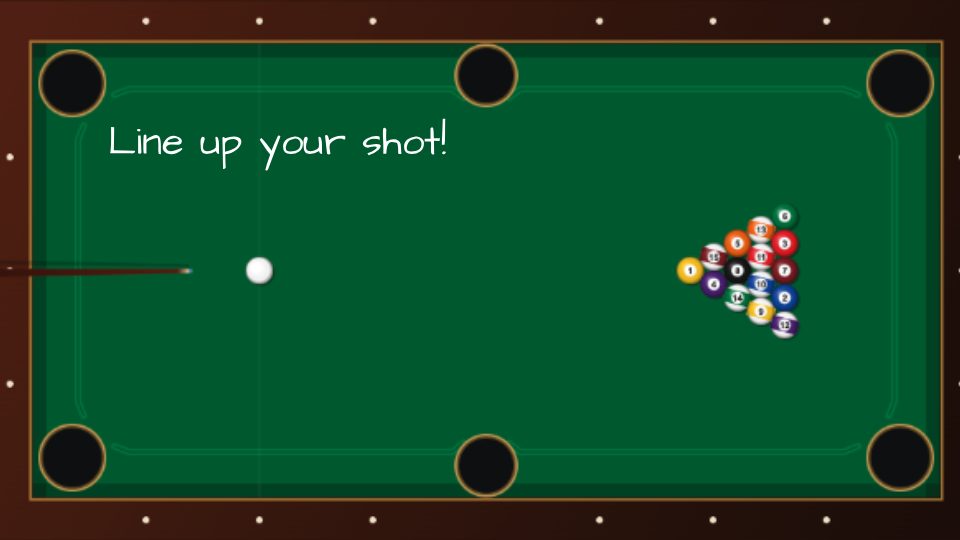
Hey! Welcome to the table. Whether you're here to line up the perfect bank shot, run some practice drills, or challenge a friend to a fast-paced game of 8-ball, you're in the right spot. We built this game to feel as close to a real table as possible, complete with smooth ball physics, solid cushion rebounds, and official rules. To make a shot, simply move your mouse or swipe on your screen to aim your cue stick, and drag backward on the felt to build up power. You can even use the left and right arrow keys for fine-tuned aiming when you need that extra bit of precision to sink a tough ball!
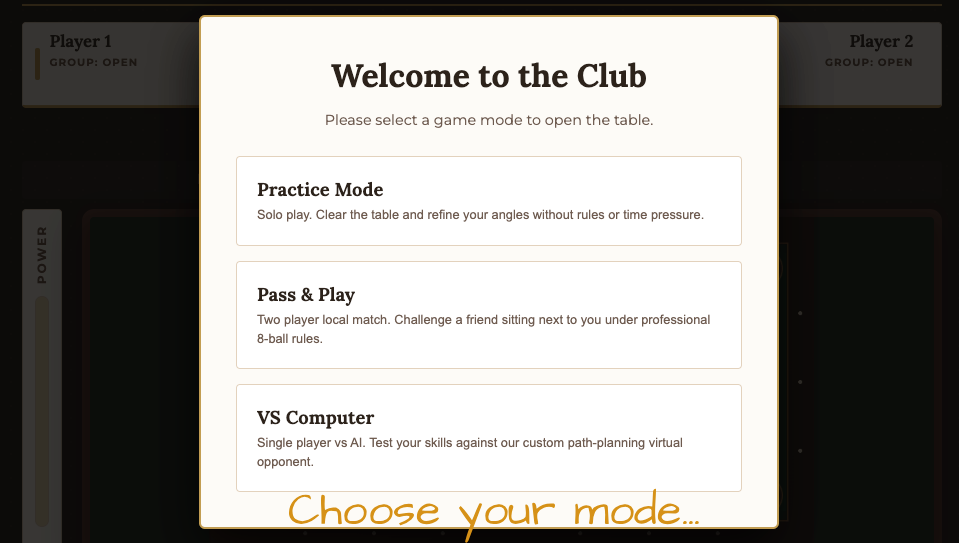
Here are the three ways you can play:
- Solo Practice: Take all the time you need. No opponent, no timer, just you, the balls, and the table to run drills and test angles.
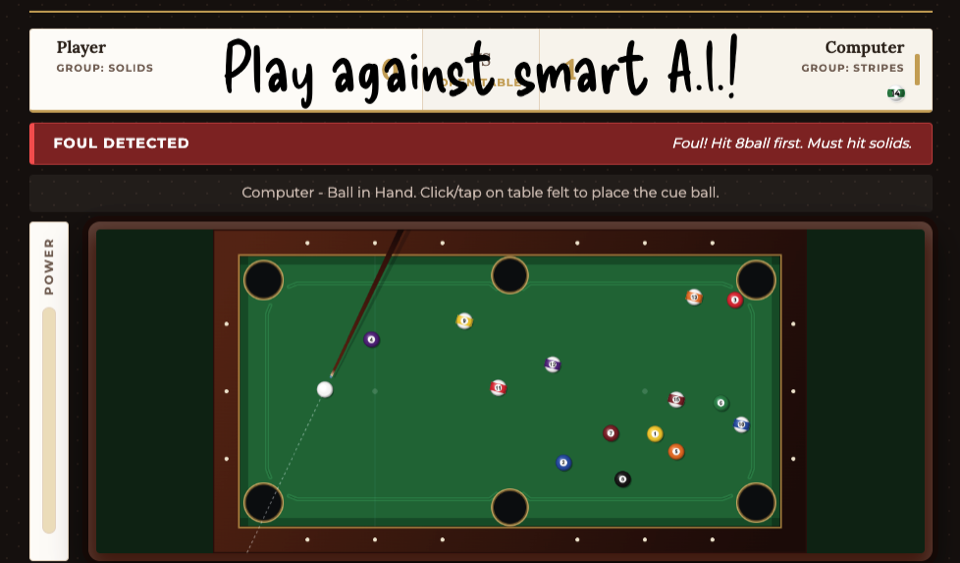
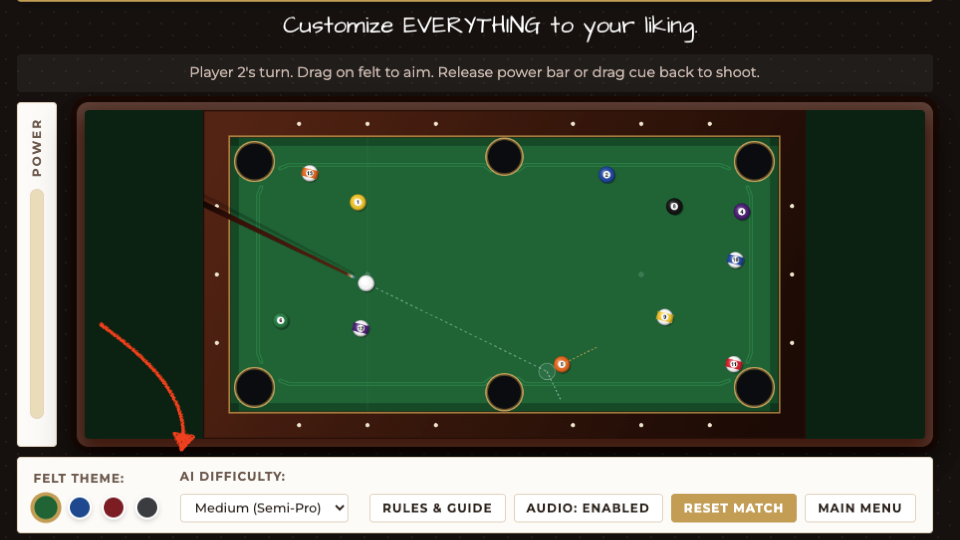
- VS Computer: Ready for a match? Face off against our built-in computer player and adjust the difficulty level to match your game.
- Pass & Play: Sitting next to a friend? Go head-to-head in a classic local two-player game, taking turns on the same device.
Chalk up your cue, check your stats at the top of the screen to watch your score and time, and let's see what you can sink!
How to Play
Choose Your Game Mode
Before hitting the table, select your desired match format. Choose Solo Practice to play without an opponent and refine your table layout strategies.
Select VS Computer to compete against the built-in AI, configuring difficulty settings to match your skill level, or choose Pass & Play to play local turns with a friend.
Master Orbit Aiming
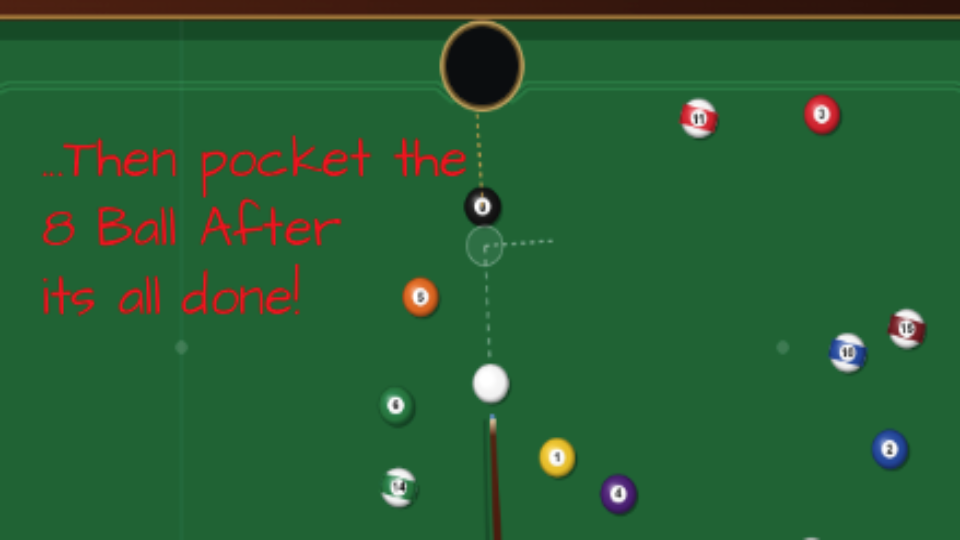
Click and drag your mouse (on desktop) or swipe your finger (on mobile) anywhere on the cloth. The cue stick will dynamically orbit the cue ball to align your shot.
A primary white target line will project from the cue ball, demonstrating the alignment path toward the target object ball to help you pocket it.
Set Power & Strike
Locate the vertical power slider on the side of the display or pull back directly on the cue stick. The indicator gauge fills to represent the force transferred to the shot.
Carefully adjust the slider to match the distance and speed needed to pocket the ball without causing the cue ball to scratch. Once aligned, release to strike.
Follow Tournament Rules
Once the break occurs, pocketing a solid (1-7) or striped (9-15) ball establishes your target set. You must always strike your own ball group first.
After pocketing all seven of your group balls, legally pocket the black 8-ball in your nominated pocket to claim victory and win the match.
The Complete Billiards & Pool Handbook
This reference handbook provides a historical and technical breakdown of pocket billiards. It covers the evolution of the sport from 15th-century lawn games to modern slate-bed tables, explains the standard regulations of official pool formats (8-ball, 9-ball, and straight pool), details the mathematical application of the Tangent Line and deflection angles in ball physics, and index-lists essential terminology.
Understanding these geometric principles and historical rules serves to improve table visualization and shot-planning strategies during competitive play.
1. The History and Evolution of Billiards
The game of billiards boasts a long and noble lineage, tracing its origins back to the 15th century in Northern Europe. Originally played as an outdoor lawn game closely resembling modern croquet, it was primarily enjoyed by royalty and the nobility in France and Great Britain.
During the reign of King Louis XI of France in the late 1400s, the sport was moved indoors to wooden tables covered in green cloth. The fabric was dyed green to mimic the color of grass, and borders (known as cushions) were added to prevent the ivory balls from falling off the table edges.
In its infancy, indoor billiards was played with wooden clubs called maces. The mace featured a heavy head on one end, which players used to push the balls rather than strike them.
By the late 17th century, the cue stick was developed as a solution to a common playing problem: when a ball rested close to a cushion rail, the large mace head was too bulky to execute a clean shot. Players began flipping the mace around to strike the ball with the thin, tapered handle, which they referred to as the queue (the French word for tail). Over time, this became the modern cue stick.
The Industrial Revolution brought major technological advancements to the sport. In the early 19th century, slate beds replaced wooden table tops, providing a perfectly flat surface that resisted warping caused by humidity.
Additionally, vulcanized rubber cushions, patented in the mid-1800s, replaced felt-stuffed rails, resulting in a predictable and consistent bounce. The word pool originally referred to a collective betting pot used in horse racing. Because pocket billiard tables were installed in betting parlors to keep patrons entertained between races, the game of pocket billiards eventually became widely known as pool.
2. Popular Pocket Billiards Formats and Official Rules
Pocket billiards has evolved into several standardized international variations, each with its own set of strategic demands and rule sets. The most widely played formats are Eight-Ball, Nine-Ball, and Straight Pool.
Eight-Ball Pool
Eight-ball is a call-shot game played with a cue ball and fifteen object balls numbered 1 through 15. The object balls are divided into two groups: solids (numbered 1 through 7) and stripes (numbered 9 through 15).
The 8-ball acts as the game-winning ball. To begin, the balls are racked in a triangle at the foot spot, with the 8-ball positioned in the center, a solid ball at one rear corner, and a striped ball at the other.
On the opening break, the player must pocket an object ball or force at least four object balls to hit the cushions. Once a player legally pockets an object ball after the break, their group (solids or stripes) is determined.
The active player must always hit their own group of balls first. Pocketing any of their own group allows them to continue their turn. If a player fails to pocket a ball, fouls, or scratches, their turn ends.
A foul (such as hitting the opponent's ball first or scratching the cue ball into a pocket) gives the opponent ball-in-hand, meaning they can place the cue ball anywhere on the table.
To win, a player must pocket all seven of their group balls and then legally pocket the black 8-ball in a nominated pocket. Pocketing the 8-ball prematurely, scratching while shooting the 8-ball, or pocketing it in an uncalled pocket results in an immediate loss of the game.
Nine-Ball Pool
Nine-ball is a fast-paced rotation game played with balls numbered 1 through 9. The balls are racked in a diamond shape with the 1-ball at the front apex and the 9-ball positioned directly in the center.
The core rule of nine-ball is that the player must always strike the lowest-numbered ball on the table first. However, the balls do not need to be pocketed in numerical order; as long as the cue ball contacts the lowest-numbered ball first, any object ball that is subsequently pocketed is considered a legal shot.
This rotation rule allows for unique offensive strategies, such as combination shots, where a player hits the lowest-numbered ball into the 9-ball to pocket it and win the game immediately.
Fouls in nine-ball also award the opponent ball-in-hand anywhere on the table. Because of the quick pace and the potential to win at any moment, nine-ball is highly favored in professional tournaments and broadcast television.
Straight Pool (14.1 Continuous)
Straight pool is a classic point-scoring game where players can shoot any ball on the table in any order. Each pocketed ball is worth one point. Before shooting, the player must call the ball and the intended pocket.
When fourteen of the fifteen balls are pocketed, the game stops. The pocketed balls are then re-racked at the foot spot, leaving the apex space empty.
The fifteenth ball remains where it rested, and the player uses it to shoot and scatter the rack, continuing their run. This continuous racking cycle requires high-level positional play and concentration.
3. Physics, Geometry, and Cue Ball Spin Control
Billiards is a game of applied physics and geometry. To play at a high level, players must understand how friction, velocity, and rotational spin affect both the cue ball and the object balls.
The Tangent Line Rule
The foundation of aiming in billiards is the tangent line. When a sliding cue ball (a ball with no topspin or backspin) collides with an object ball, the cue ball will travel along a path that is exactly perpendicular (90 degrees) to the line of contact between the two balls.
This means that regardless of the angle of impact, the cue ball will deflect sideways along this 90-degree line. By visualizing the tangent line, players can predict where the cue ball will roll and prevent it from scratching.
Topspin (Follow) and Backspin (Draw)
Striking the cue ball above its center point applies topspin (follow). As the cue ball travels, it rolls forward. Upon colliding with the object ball, the topspin causes the cue ball to bend forward, moving ahead of the natural 90-degree tangent line. This is crucial for advancing the cue ball down the table to set up the next shot.
Conversely, striking the cue ball below its center applies backspin (draw). When the cue ball contacts the object ball, its forward momentum is transferred to the object ball, and the backspin bites the cloth, pulling the cue ball backward. This is the primary tool for stopping the cue ball in place or pulling it back to safety.
Sidespin (English)
Applying spin to the left or right of the cue ball's vertical axis is called English. Sidespin does not affect the path of the object ball significantly, but it alters the rebound angle off the cushion rails.
Left spin makes the ball rebound wider to the left, while right spin makes it rebound wider to the right. Advanced players use sidespin to escape difficult safety positions, curve around blocking balls, and navigate the cue ball around the table cushions.
4. Comprehensive Billiards Glossary of Terms
Cue Ball
The white, unmarked ball that the player strikes directly with the tip of the cue stick.
Object Ball
Any of the colored and numbered balls that the player aims to pocket using the cue ball.
Scratch
A foul that occurs when the cue ball is pocketed or knocked off the table, resulting in a penalty.
Break
The opening shot of a match, executed from behind the kitchen line, designed to scatter the racked object balls.
Rack
The triangular or diamond-shaped wooden or plastic frame used to gather and align the object balls at the start of a game.
Cushion
The felt-covered rubber borders lining the inside of the rails that bounce the balls back into play.
Chalk
A blue, abrasive substance applied to the leather cue tip to increase friction and prevent miscue slips.
Bridge
The positioning of the player's non-dominant hand on the table cloth to guide and steady the cue stick.
Combination Shot
A shot where the cue ball strikes an object ball, which then collides with and pockets another object ball.
Carom
A shot where the cue ball strikes one object ball and rebounds off it to strike a second object ball or a cushion rail.
Bank Shot
A shot where the player drives the object ball into one or more cushion rails before it goes into a pocket.
Kick Shot
A shot where the cue ball is bounced off a cushion rail before striking the target object ball.
Safety Shot
A defensive shot intended to leave the opponent in a difficult position on the table, often without a direct shot.
Miscue
A failed strike where the cue tip slides off the cue ball without transferring energy, often caused by a lack of chalk.
Frozen Ball
A ball that is resting in direct contact with another ball or against a cushion rail.
Double Kiss
An accidental secondary collision between the cue ball and an object ball, typically occurring near a rail or pocket.