Play Go Fish Online Free
Ask opponents for matching ranks and assemble complete four-card sets.
Loading game...
About Go Fish
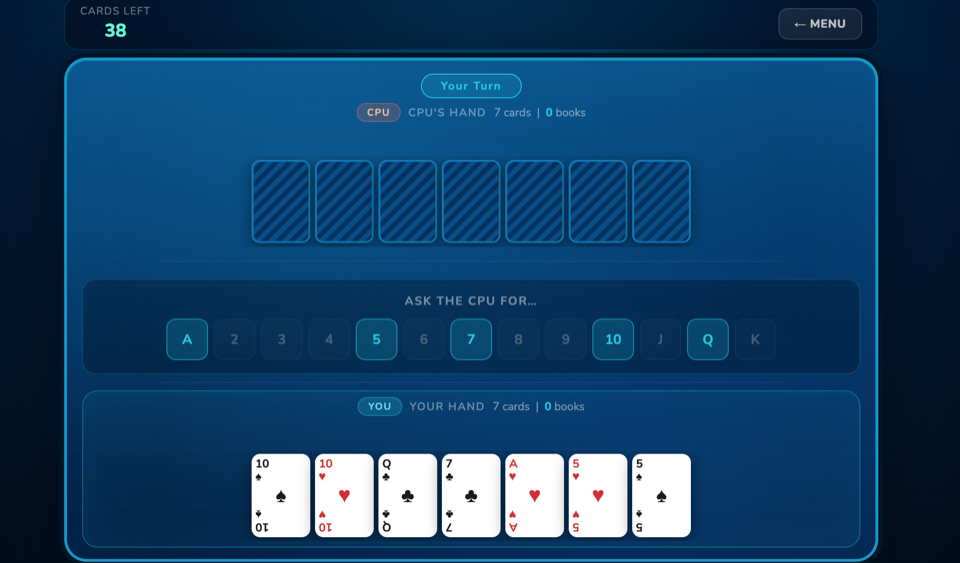
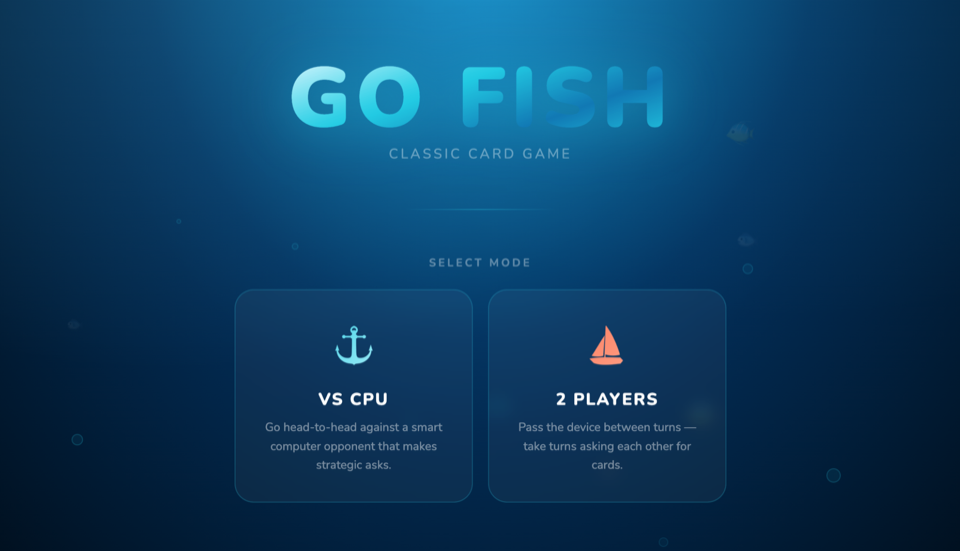
Welcome to Go Fish, our modern digital rendition of the classic card matching game loved by players of all ages! The goal is simple: collect as many complete sets of four matching ranks (known as books) as possible by asking your opponent for cards or drawing from the central ocean deck. Our adaptation features two primary modes: a smart CPU opponent that dynamically tracks your requests to form its own cards, and a local pass-and-play two-player mode to play with friends on the same device.
You can easily navigate back to the main menu or start a fresh match at any time using the clean layout buttons. The card deck is shuffled randomly at the start of every game to ensure a fair and unique distribution. Refine your memory, deduce what cards your opponent is holding, and collect the most books to win the match!


How to Play
Choose Your Game Mode
Pick either a solo match against the strategic CPU or a local two-player pass-and-play match against a friend.
Request Ranks
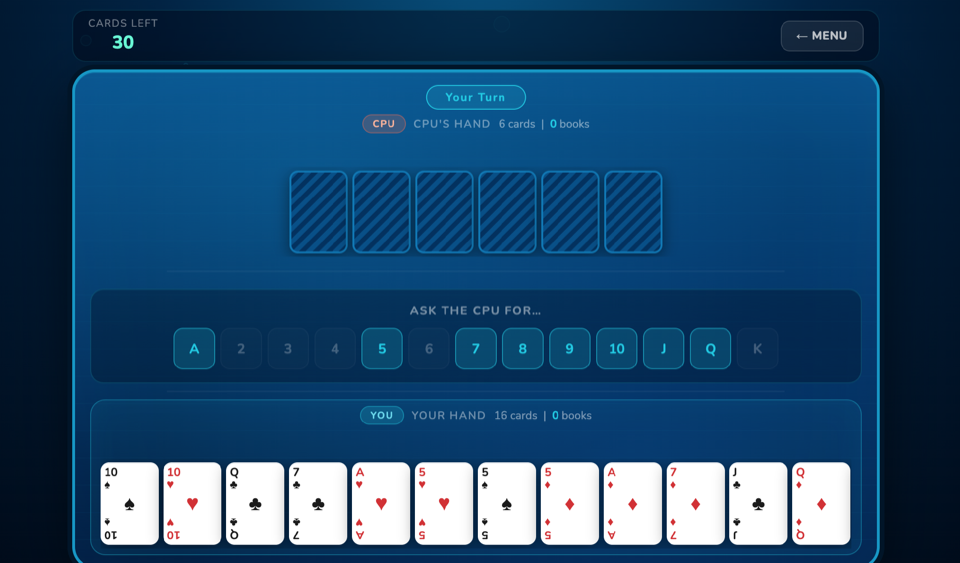
Select any card rank you already hold in your hand on your turn to ask your opponent if they possess any matches.
Handle the Response
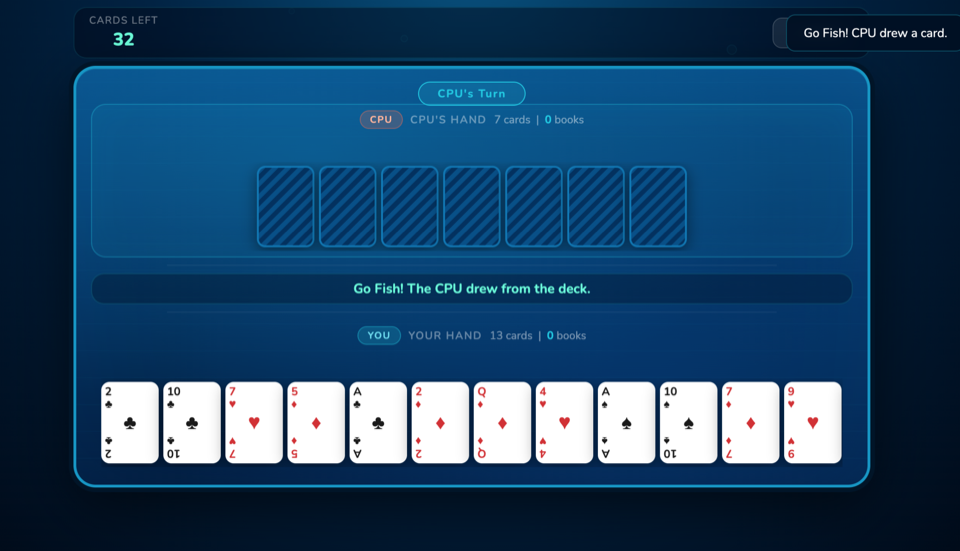
Take matching cards from your opponent to keep your turn, or draw from the deck (Go Fish!) if they have none.
Complete the Books
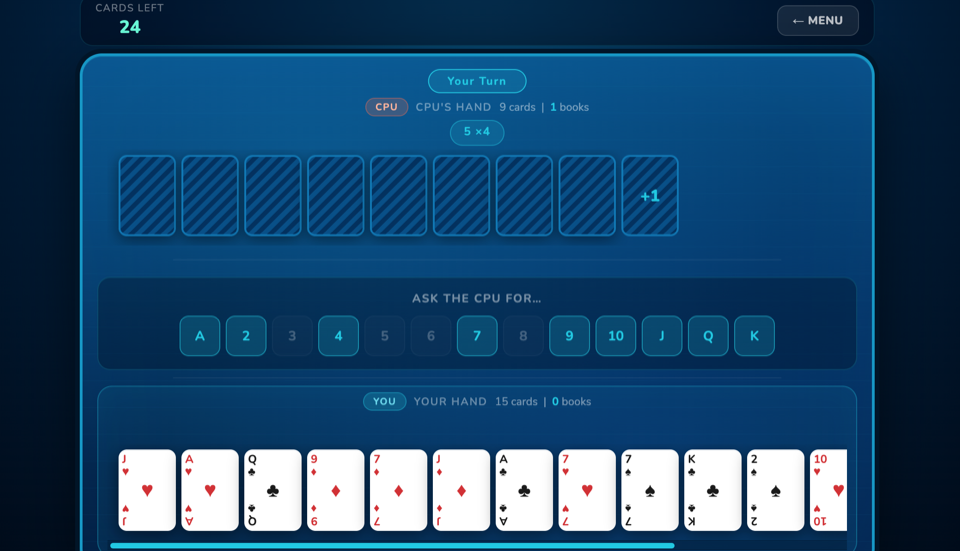
Form sets of four matching cards to place them in your books pile, aiming to collect the majority of the thirteen sets.
Target high frequencies
Ask for ranks you hold multiple copies of. This maximizes the probability of finding a match while thinning your opponent's cards.
Track opponent queries
Pay close attention to what your opponent requests on their turns. This reveals the cards in their hand, allowing you to block them or take them later.
Protect empty hands
If you run out of cards, you must immediately draw one from the deck. Plan your books carefully to avoid leaving yourself cardless.
Go Fish Player Handbook
This friendly strategy guide is packed with helpful tips, card history, and probability tactics to help you win at Go Fish rules. You will learn memory-tracking tricks to follow what cards your opponent holds.
By keeping a close eye on the cards, you can turn a simple game of luck into a rewarding matching battle. Let's dive in and start fishing!
1. The Historical Journey of Card Matching
Did you know that card matching games started in Europe all the way back in the sixteenth century? Go Fish is actually a direct descendant of a traditional British game called Happy Families, which was created in 1851.
Happy Families used cards showing different trade families, and players had to ask opponents for specific cards to complete the sets. In other parts of Europe, similar card matching games like Quartett followed these same fun collection rules.
The catchy name Go Fish became popular in North America during the early 1900s as a simpler game for children. It refers to the fun act of drawing cards from the center pile when an opponent does not have the rank you requested.
Learning about these classic card games shows us how simple set-collecting rules became popular all around the world. Today, families everywhere still play this beloved game to test their memory and share a laugh.
2. Deck Probability and Card Matching Math
While the colorful sea creatures on the cards look friendly, there is some fun math happening under the water. A standard deck of fifty-two cards contains thirteen ranks, which means exactly four cards of each value are in play.
When a new game starts, each player is dealt seven cards, which leaves thirty-eight cards in the central draw pile. Finding the exact rank you want is a puzzle that depends on how many cards are already in your hand.
For example, if you hold two Queens, you know there are only two other Queens hidden somewhere on the board. The chance that your opponent holds those Queens changes every time cards are drawn or traded.
As the draw pile gets smaller, your chances of catching the exact card you need from the ocean go up quickly. Smart players keep track of how many cards are left to know when to ask for a rank or when to just take a chance and fish.
3. Cognitive Memory and Strategic Hand Deductions
While card probabilities are useful, the real secret to winning is simply paying close attention to the game. Successful players do not just guess randomly; they listen carefully to every card their opponents ask for.
When your opponent asks you for a specific rank, you know right away that they are holding at least one of those cards. Try to remember this detail so you can ask for that same rank when your turn comes back around.
Similarly, if your opponent asks for a card and gets told to fish, you know they did not find what they wanted. This helpful clue lets you narrow down which ranks are still hidden in the draw pile.
You can also watch the board closely whenever your opponent draws a card from the deck. If they complete a book right after drawing, you can guess which cards they had been holding in their hand.
Using these simple memory habits turns a game of simple luck into a fun match of visual deduction. Keep your ears open, remember past requests, and you will clear the board in no time.
4. Glossary of Terms
Match
The act of collecting cards of the same rank to group them together. In this game, you match all four suits of a rank to form a completed book.
Go Fish
The command you say when you do not hold the card rank requested by your opponent. The asking player must then draw a card from the ocean.
The Ocean
The friendly term for the central pile of face-down cards on the table. Players draw from this pile whenever they are told to fish.
Rank
The numerical or face value of a card, ranging from Ace through King. Ranks are the primary focus of all card requests and books.
Deduction
The smart process of figuring out which cards are in an opponent's hand based on their previous asks. This skill is the secret to high-level play.
Book
A completed set containing all four cards of a single rank. Once you collect a book, you remove it from your hand to score points.
Deck
The standard pack of fifty-two playing cards used to play the match. The deck is divided into four suits of thirteen ranks.
Hand
The private collection of cards held by an individual player. You must keep your hand hidden from opponents during the match.