Play Color Cards Online Free
Match colors and numbers to empty your hand before computer opponents.
Loading game...
About Color Cards
Welcome to Color Cards, a sleek and fast-paced card shedding game designed to test your tactical thinking and card management skills! In this modern take on classic matching games, your main goal is to empty your hand of cards before any of the computer opponents can do the same. You will play on a beautiful, responsive digital board against up to 3 smart artificial intelligence players with customizable rule options.
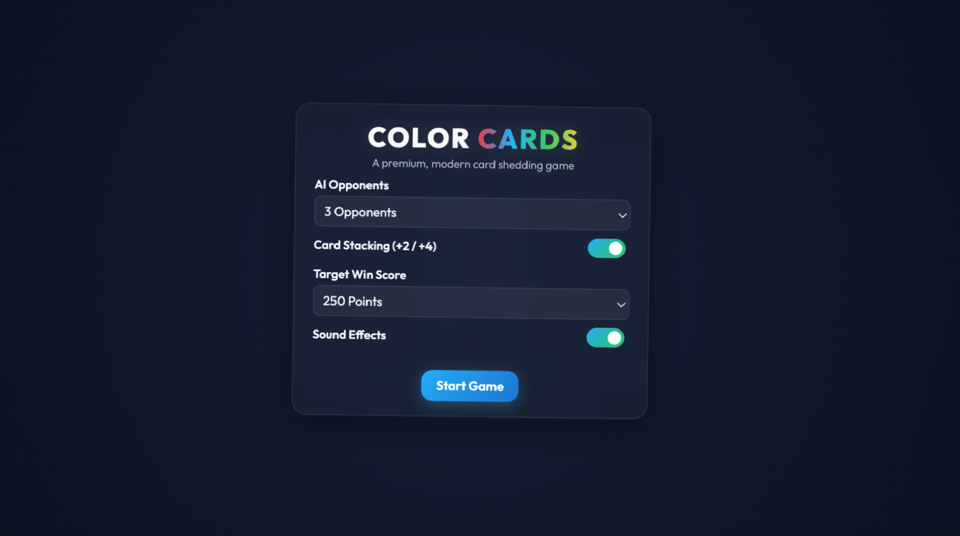
You can toggle special stacking rules on the lobby screen to allow players to pass card drawing penalties forward to the next person. Win points at the end of each round based on the values of the cards remaining in your opponents' hands. Color Cards offers several premium highlights to make every game round feel exciting:
- Custom Game Rules: Toggle card stacking options and choose opponent counts from 1 to 3 to adjust the difficulty.
- Target Score Modes: Play a single round or set a target score of up to 500 points to win the entire match.
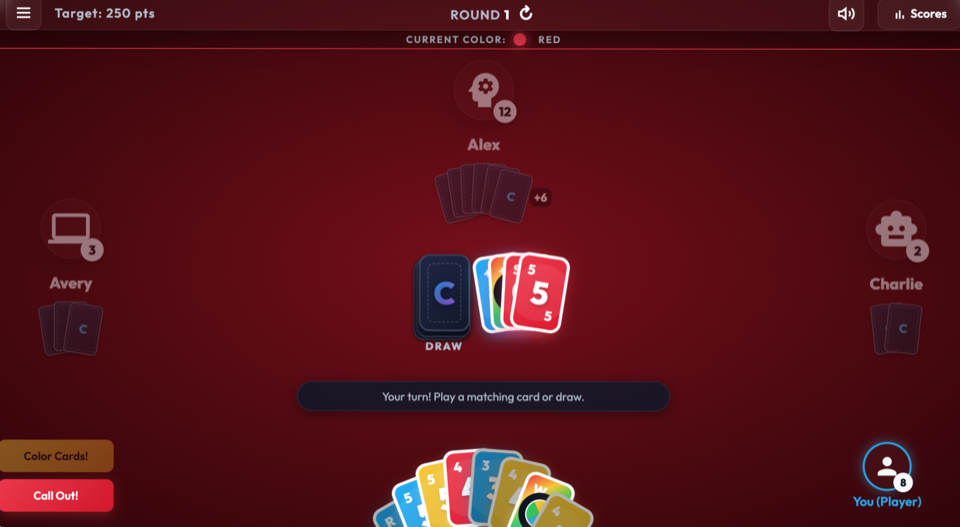
- Helpful Layout Aids: Track turn rotations and the active color at a glance using the status indicators in the header.
- Responsive Deck Animations: Watch cards slide and flip smoothly on a screen optimized for both desktop and mobile views.
How to Play
Step 1
Select your preferred settings on the lobby screen, including the number of opponents, target win score, and stacking rules. Click the start button to deal seven cards to each player and flip the first card face-up.
Step 2
On your turn, choose a card from your hand that matches the color or number of the face-up card in the center. If you do not have any matching cards, click the deck to draw one new card.
Step 3
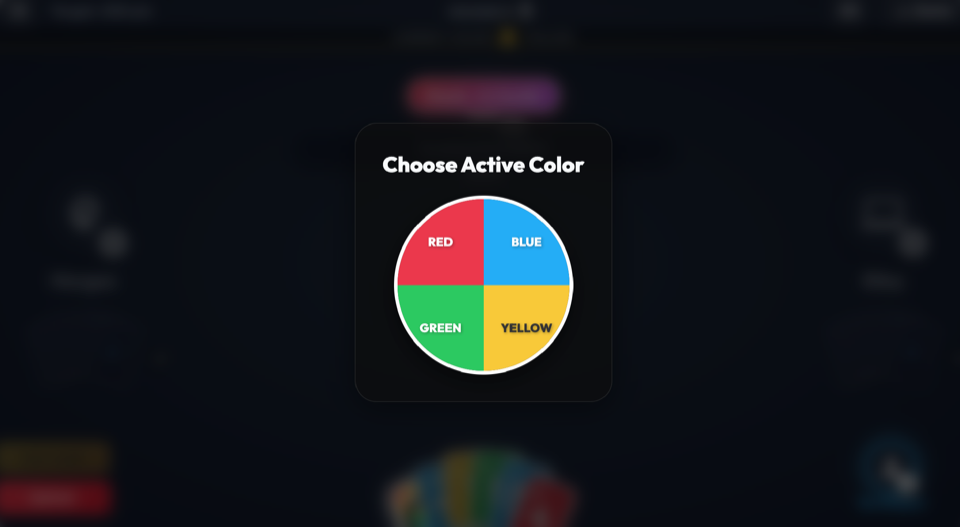
Play special action cards like skips, reverses, and draw-two cards to disrupt your opponents' strategy and gain control. Wild cards let you change the active color to whatever suit benefits your hand the most.
Step 4
Empty your hand to win the round and score points based on the cards your opponents are still holding. The first player to reach the target score selected at the beginning wins the entire game.
Wild Timing
Keep your wild cards in hand until you have no other matching moves left.
Stacking Strategy
Save your penalty cards to defend against draw penalties passed to you by other players.
Color Tracking
Watch what colors your opponents pass on to guess what suits they are missing.
Color Cards Player Handbook
Ready to win some matches in Color Cards? This guide covers the mathematical card distribution, stacking rules, and strategies for outsmarting the computer players.
Matching and dumping cards takes planning but it is easy to master with a few tips. Let us look at how the game works and how you can outplay the AI.
1. Understanding the Card Deck
If you want to win at Color Cards, you need to understand how the custom 108-card deck is set up. Modern 108-card color matching games have a rich heritage in playing card history, evolving from 1970s family parlor games into a vibrant challenge split across four colors and special action cards.
Knowing which cards are in the deck helps you decide when to play aggressively. Most of the cards you draw will be simple numbers, while action cards like skips are much harder to find.
Each color has one 0 card and two of every number from 1 to 9. This means basic numbers make up the bulk of what you will hold during a match.
The special action cards include skips, reverses, and draw penalties that let you disrupt other players. There are 32 of these cards in the deck, so they pop up quite often.
The wild cards are the most valuable cards in the deck since they let you change the active color. You will find 8 wild cards in total, and they can be played on any card in the pile.
Whenever the draw pile runs out, the game will automatically shuffle the discard pile to keep things moving. This means you can focus entirely on your next move without worrying about the deck.
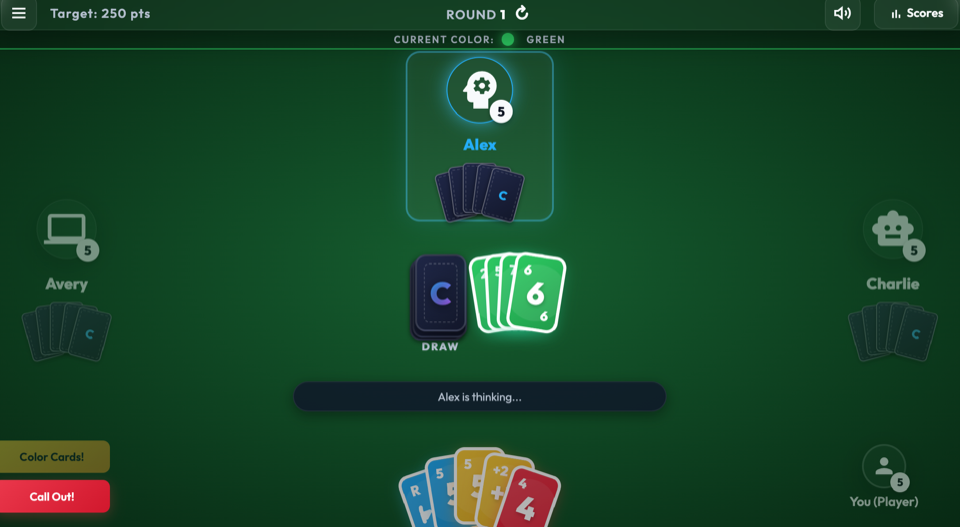
The digital table is laid out with your hand at the bottom and the other players around the sides. This view makes it easy to keep track of how many cards everyone else has left.
Watching how many cards your opponents are holding is key to planning your next move. You do not want to let someone sneak a win because you were not paying attention to their hand.
2. Turns, Stacking, and Point Values
The game starts going clockwise, but playing a reverse card will flip the direction of play. You can watch the arrow indicator in the top header to see who goes next.
Keeping track of the turn direction is essential when you want to block an opponent. You can time your skips or draw penalties to hit the player who has the fewest cards.
If you turn on stacking in the lobby, you can chain draw-2 and draw-4 cards together. This allows you to pass a drawing penalty to the next player if you have a matching card.
The penalty keeps growing and passing along until someone cannot match the draw symbol. That player has to draw the full pile of penalty cards and loses their turn.
This makes draw cards great defensive tools to save for when you get attacked. If you play them too early, you might get caught with no way to block a big penalty.
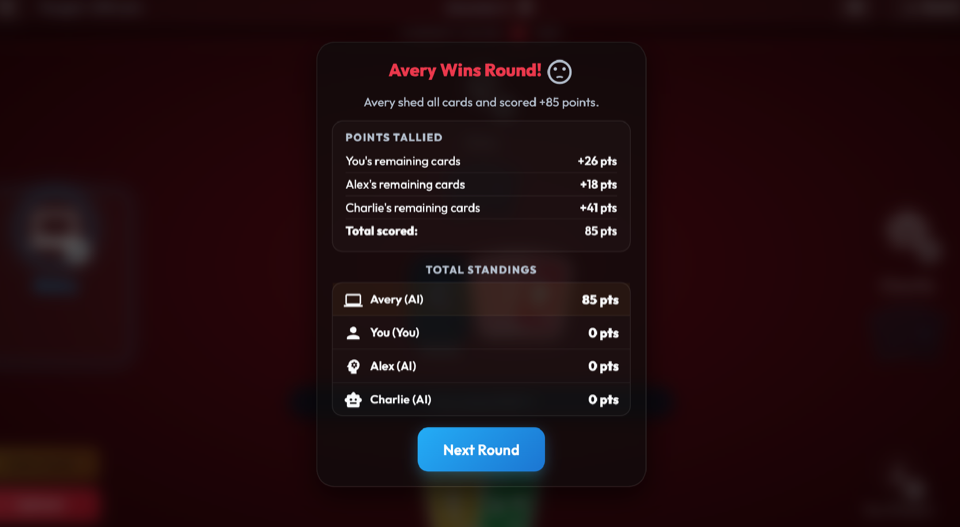
At the end of a round, any cards left in your hand are counted as points for the winner. Number cards are worth their face value, so a 9 card costs you 9 points.
Action cards like skips and reverses cost 20 points if you are caught holding them. Wild cards are even worse and add 50 points to your total if you lose.
Because of this, you should try to get rid of your high-value cards early in the round. Keeping a hand full of wild cards is risky if someone else is about to win.
The standings screen tracks these points after every round until the match limit is reached. You can view the scoreboard anytime to see who is leading the game.
3. How to Beat the Computer Players
The computer bots are smart and will try to play their highest-value cards first. They also keep track of what colors you play to figure out what you are missing.
To beat them, you need to keep a good balance of different colors in your hand. If you only hold one color, a single wild card play can lock you out of the game.
If you see a bot drawing cards repeatedly on green, they probably do not have any green cards. Try to keep the pile green to force them to draw even more cards.
Saving your wild cards for your final few turns is a great way to guarantee a win. They give you a backup option when you only have 1 card left to play.
You should also watch for when a bot is down to their last card. That is the perfect moment to play a skip or reverse to take away their turn.
When stacking is enabled, do not play your draw cards unless you have to defend yourself. Saving them keeps you safe from getting hit with a massive draw penalty.
You can use the standings button to check how close everyone is to the target score. This helps you decide which player you need to target with your action cards.
The bots will not hesitate to stack cards against you if you get too close to winning. Keep your defensive cards ready to bounce those penalties back at them.
With a little practice, you will start noticing patterns in how the bots play their hands. Use those patterns to plan your moves and clear your hand before they do.
4. Fun ways to test your skills
Action Master
Play 3 action cards in a single round to disrupt the turn order. This challenge helps you practice controlling the game pace.
Stack Defender
Use stacking rules to successfully pass a draw penalty forward to another player. You will need to hold a draw card in your hand until you are attacked.
Wild Winner
Win a round by playing a wild card as your very last card. This requires you to save a wild card for your final turn.
Low Score Shield
Complete a 4-player match with a total score under 50 points across all rounds. You must dump high-value action and wild cards as fast as you can.
Clean Sweep
Win a round without drawing a single card from the central deck. You will need a lucky starting hand and smart matching choices on every turn.
Grand Champion
Reach the target score and win the match against 3 computer opponents. This is a great test of your card management skills over multiple rounds.