Play Number Tiles Online Free
Slide squares together to merge identical values toward the 2048 goal.
Loading game...
About Number Tiles
Welcome to Number Tiles, our version of the iconic 2048 puzzle! The premise is brilliantly simple: you have a 4x4 grid, and every swipe slides all the tiles on the board in one direction. Any two tiles that share the same number and crash into each other merge into one tile worth double the value. After every single move, a new tile worth 2 spawns somewhere on the board. Your goal is to keep merging tiles up the chain: 2 becomes 4, 4 becomes 8, 8 becomes 16, and so on, all the way to 2048.
Every merge adds its combined value directly to your score, which syncs live to the stats bar at the top of the page, with your personal best saved automatically. Use the arrow keys to slide on desktop or swipe in any direction on mobile and tablet. The Restart button above the grid wipes the board and starts you fresh at any point, no page reload needed.
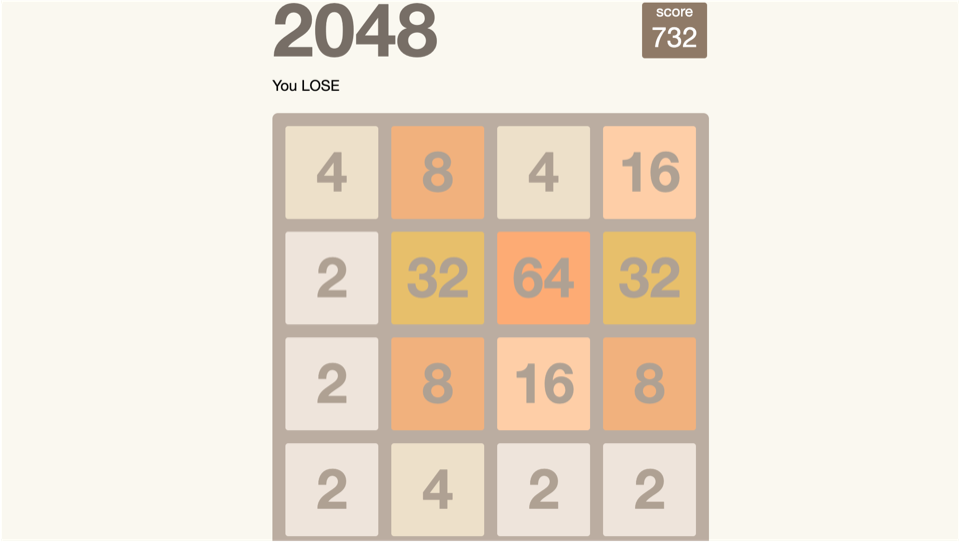
The game ends when no empty cells remain and no two adjacent tiles share the same number. A few careless moves can lock the board completely, so every slide counts. See how high you can push your tiles!
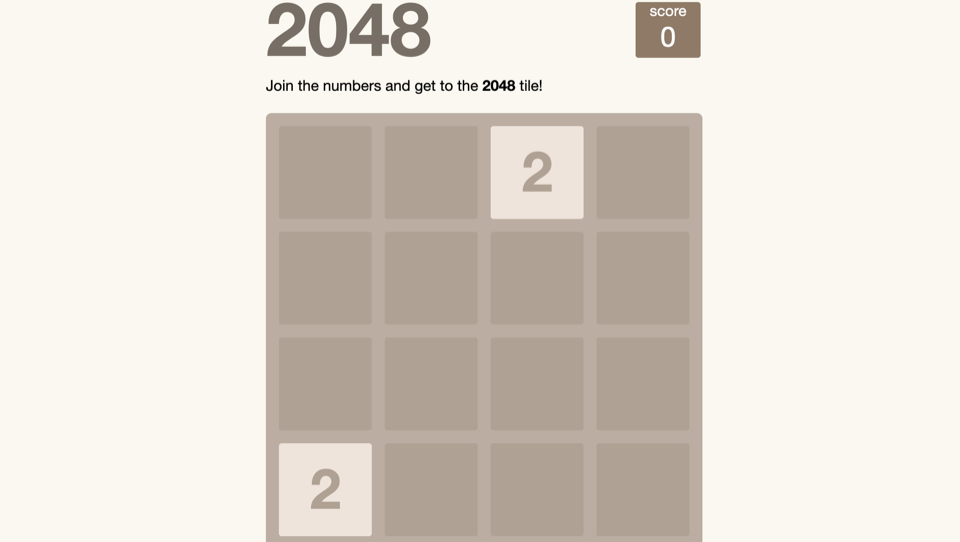
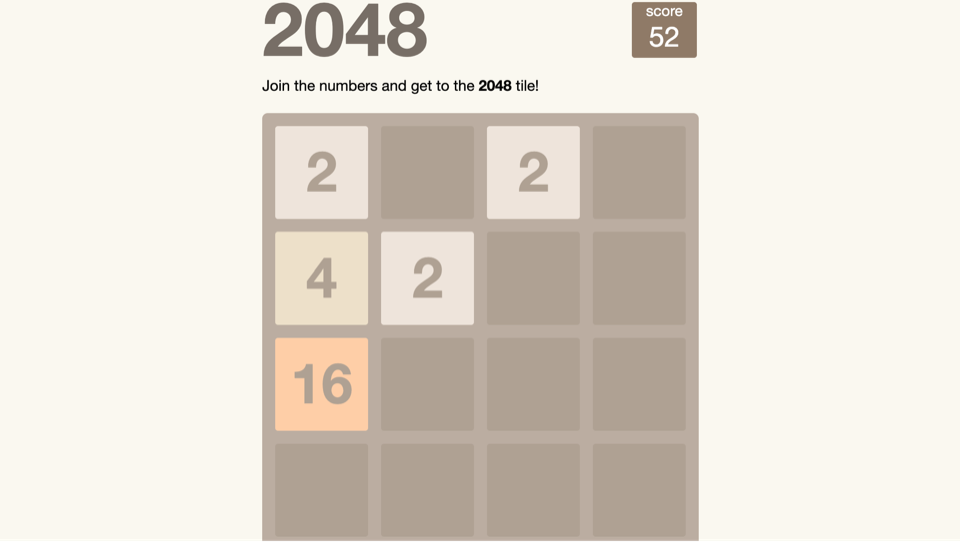
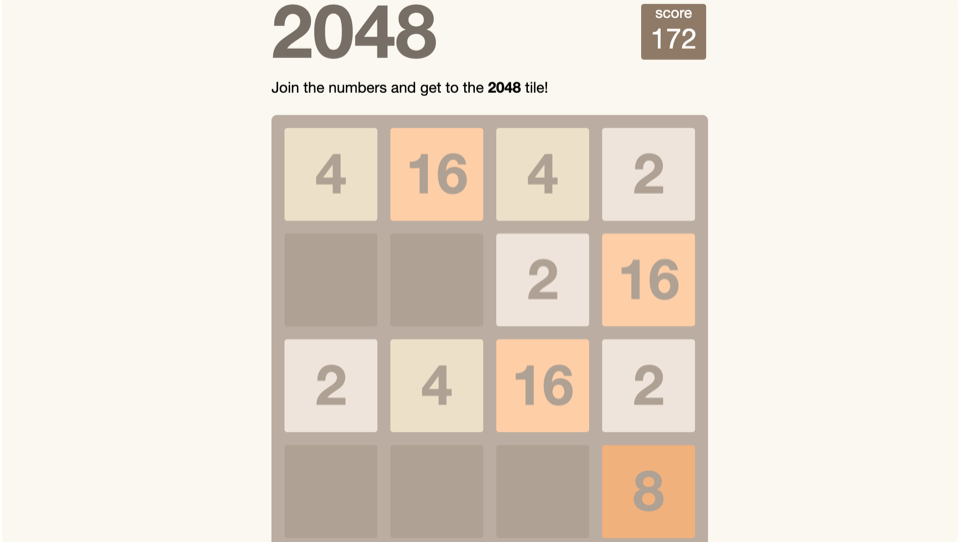
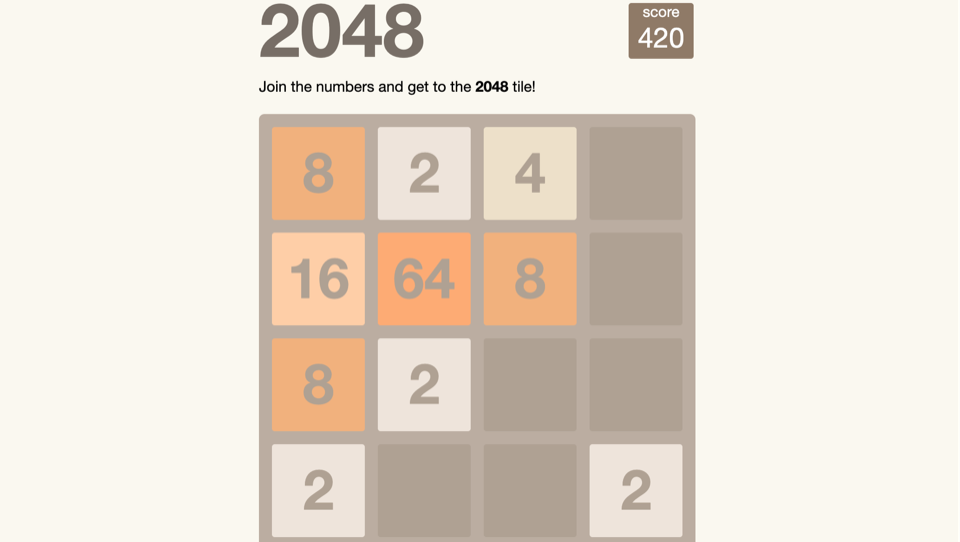
How to Play
Slide to Move
Use the arrow keys (or swipe on touch screens) to push all tiles on the board in one direction at once. Every tile slides as far as it can go in that direction before stopping at the grid edge or another tile.
Merge Matching Tiles
When two tiles with the same value collide after a slide, they merge into one tile worth their combined total. A pair of 4s becomes an 8, two 16s become a 32, and so on. Only one merge can occur per tile per move.
Score Your Merges
Every time two tiles merge, their combined value is added to your score, which is displayed in the stats bar at the top of the page. The bigger the merge, the more points you earn. Your all-time best score is saved automatically.
Avoid Filling the Grid
After every move, a new tile worth 2 appears in a random empty cell. The game ends when the grid is completely full and no adjacent tiles share the same number. Plan your slides to keep as many cells free as possible.
Lock your best tile in a corner
Pick one corner (bottom-right works well for most players) and never slide in the direction that would move your highest tile away from it. This keeps your board structure intact as you build upward.
Restrict yourself to three directions
Commit to sliding right, down, and left for the majority of your moves. Only swipe up when you have absolutely no other option, since upward swipes displace corner-anchored tiles and break your chain.
Build a descending row along the edge
Arrange your highest tiles in a descending sequence along one full row or column (for example, 512, 256, 128, 64 along the bottom). This creates a natural merge pipeline where each step feeds cleanly into the next.
Number Tiles - 2048 Player Handbook
Welcome to the complete guide for Number Tiles! Whether you just discovered this addictive puzzle or you have been chasing the 2048 tile for weeks, this handbook will give you a thorough understanding of how the game was born, how its core mechanics work under the hood, and the precise strategic techniques used by top players to push their scores into the tens of thousands.
You will find a breakdown of the original game's viral origin story, a technical explanation of the slide-and-merge algorithm, proven advanced strategies for building toward 2048 and beyond, and a full glossary of key terms. Let's start sliding!
1. Origins: A Viral Weekend Project
The original 2048 was created by Gabriele Cirulli, an Italian web developer who was just 19 years old at the time. He built it over a single weekend in March 2014 as a personal experiment to see if he could recreate the mechanics of a similar game called 1024 using cleaner code, and published it for free on GitHub.
Within one week the game had been played over 4 million times, and within a month it was one of the most-played browser games in the world. Cirulli was genuinely surprised by the response, having shared it with no marketing or promotion of any kind.
The concept itself was influenced by Threes!, a premium mobile game released two months earlier by Asher Vollmer and Greg Wohlwend, which used a similar tile-merging system on a smaller 4x4 grid. Unlike Threes!, Cirulli's version was open source and free, which accelerated its global spread and spawned hundreds of clones and variants within weeks of its release.
Today, 2048 is recognized as a landmark in casual game design. Its genius lies in the gap between how simple it looks and how deep the strategic space actually is: a game that anyone can pick up in thirty seconds but takes genuine skill to master.
2. How the Slide-and-Merge Algorithm Works
Every time you swipe or press an arrow key, the game shifts all the tiles in that direction. During a slide, the numbers slide as far as they can, packing tightly together and leaving no gaps on the board.
Once they are packed, any two adjacent tiles with the exact same number will combine into a single, larger value. A newly merged tile cannot combine again on the same turn, which keeps the game moving at a steady pace.
After the merge happens, the remaining tiles slide once more to fill any new gaps that were created. This smooth sliding behavior is what makes matching the numbers feel so satisfying.
Your score increases by the value of the new combined tile every single time you make a merge. Because larger numbers give you much bigger boosts, making big merges is the fastest way to get a high score.
3. Advanced Strategy: The Corner Anchor Method
The absolute best strategy for winning is to keep your largest number locked in one single corner of the grid. Most players choose the bottom-right corner since keeping your hand moving down and right is very comfortable.
To keep your large tile locked in its corner, you should avoid swiping in the opposite direction. For example, if your anchor is in the bottom-right, you should almost never swipe up and only swipe left when you have no other moves.
You should also try to arrange your other numbers in descending order along the bottom row. This creates a neat path where small numbers can easily merge and slide into your main corner.
When your path is organized, new numbers that appear at the top will slide down and merge together smoothly. Keeping this neat setup under pressure when the board fills up is the ultimate test of your skills!
4. Glossary of 2048 Terms
Corner Anchor
The designated corner spot where the highest-value tile is kept throughout the game. Preserving this anchor is the foundation of every winning strategy.
Full Board
The losing state where the grid is completely filled and no adjacent tiles can merge. When this happens, the game ends because no valid moves are left.
Restricted Swipes
A strategy where you avoid swiping in a specific direction (usually up) to keep your largest numbers locked in place. This control is essential for surviving the late game.
Merge
The event where two adjacent tiles of equal value collide during a slide and combine into a single tile worth their sum. Each tile can only participate in one merge per move.
Monotonic Chain
A sequence of tiles arranged in strict descending order along a row or column, where each tile is exactly half the value of its neighbor. A well-maintained monotonic chain creates an efficient merge pipeline toward the corner anchor.
Compacting
The sliding action that packs all the numbers tightly together in one direction. This happens every time you press an arrow key or swipe the screen.
New Number
The fresh number tile that appears in a random empty space after every turn. This tile usually spawns as a two or a four and cannot be controlled.
Tile Value
The number shown on a tile, which starts at two and doubles with each merge. Reaching the target value of 2048 triggers the win.