Play Memory Pattern Online Free
Memorize sequence flashes and repeat increasingly complex rounds.
Loading game...
About Memory Pattern
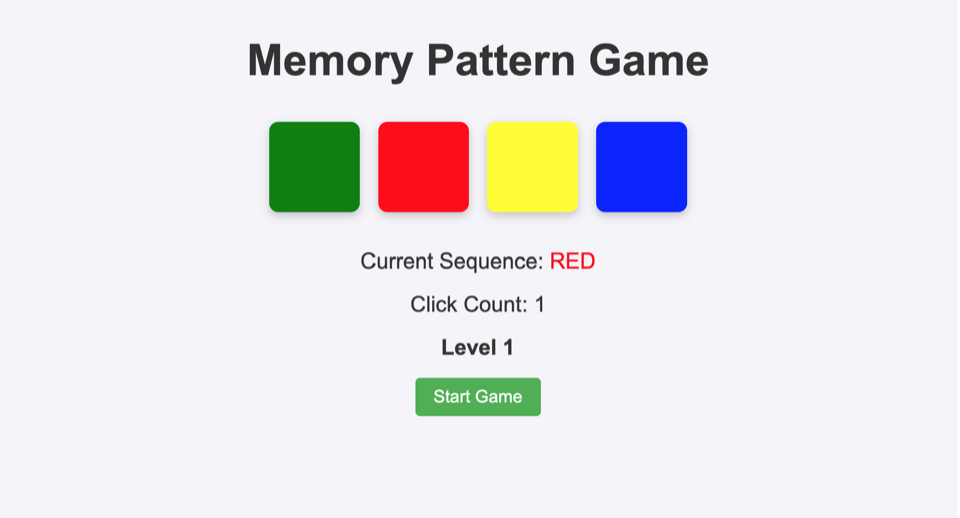
Welcome to Memory Pattern, our take on the classic Simon Says electronic game that has been testing reflexes and recall since the late 1970s! The game shows you a sequence of colored flashes across 4 buttons and you have to click them back in the exact same order. Each time you get it right, the sequence grows by 1 color, pushing your short-term memory further and further.
The challenge ramps up fast. By round 5, you are tracking a chain of 5 colors. By round 10, it feels nearly impossible unless you are using the right memory tricks. The game ends the moment you click the wrong color, so every single tap matters. Memory Pattern offers a clean and focused brain training experience:
- Growing Sequences: Each round adds 1 new color to the chain, building from a single flash all the way to sequences of 15 or more.
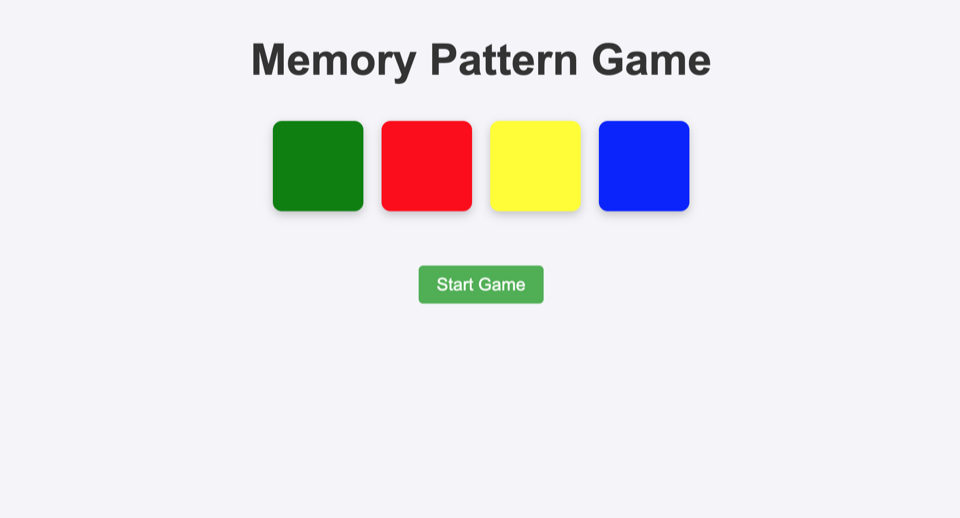
- 4 Color Buttons: Green, red, yellow, and blue flash in random combinations to test your visual recall.
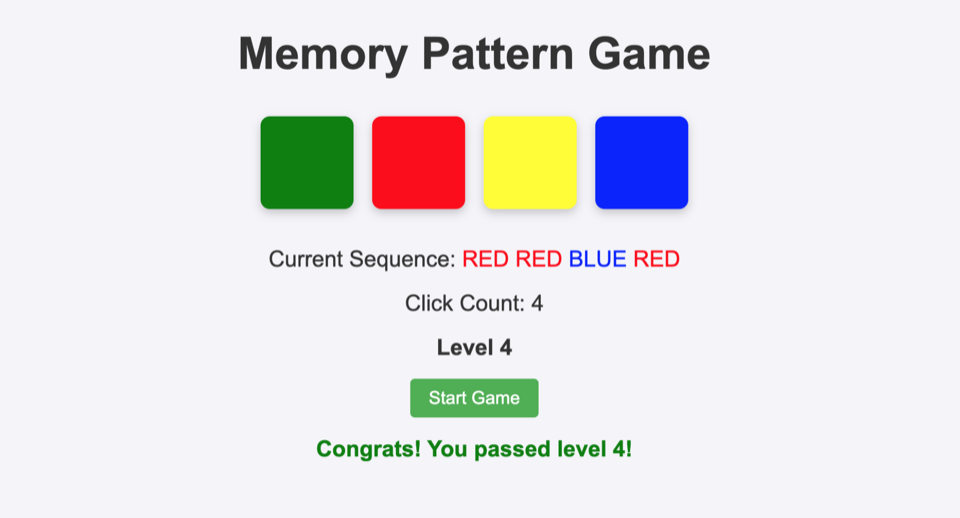
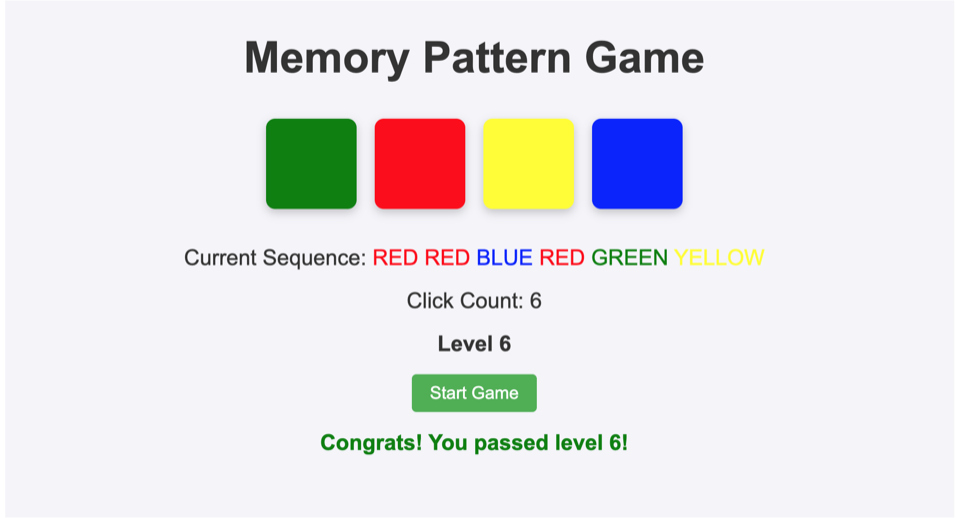
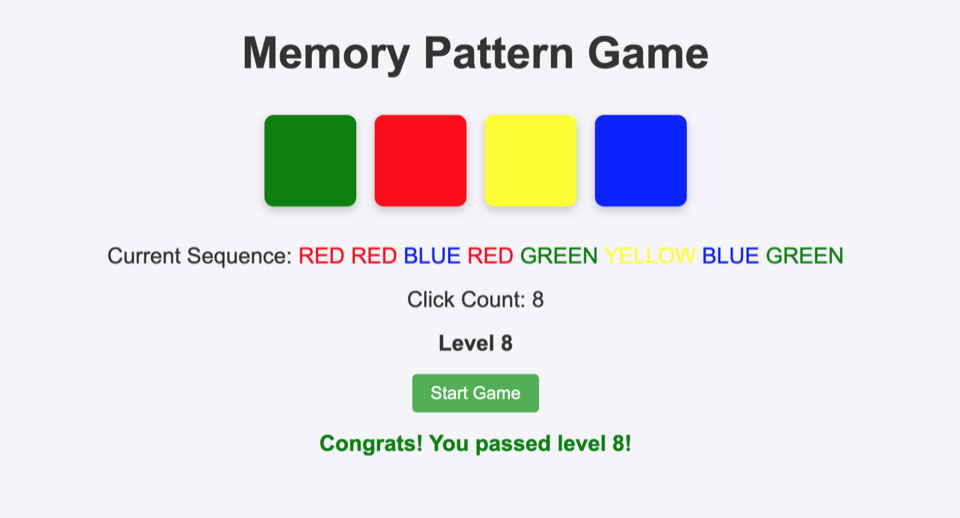
- Instant Feedback: A congrats message appears when you pass a level, and a game over screen reveals the correct color if you miss.
- Level Tracker: The current level counter and click counter keep you informed of your progress during each attempt.
How to Play
Step 1
Click the start game button to begin your first round. The game will flash 1 colored button on the screen for you to watch.
Step 2
After the flash sequence finishes, click the same colored buttons in the exact order they appeared. Each correct click advances you through the current round.
Step 3
When you complete the full sequence, a congrats message appears and the game adds 1 new color to the chain. The entire sequence replays from the beginning with the new addition at the end.
Step 4
If you click the wrong color at any point, the game ends immediately and shows you what the correct color was. Click start game again to begin a fresh attempt from level 1.
Chunking
Group the colors into chunks of 3 or 4 in your head instead of trying to remember the whole chain at once.
Verbal Labels
Say the color names out loud as the sequence plays to reinforce visual memory with an audio cue.
Spatial Anchors
Associate each color with its screen position so you can remember the pattern as a set of locations.
Memory Pattern Player Handbook
Want to survive past level 10 in Memory Pattern? This guide covers how sequence memory works, why chunking is so effective, and the specific tricks that help you recall longer and longer chains.
You do not need a photographic memory to get good at this game. A few simple habits can double how far you get, so let's break it down!
1. Where Simon Came From
The original Simon electronic game launched in 1978 and became one of the best-selling toys of all time. It was created by Ralph Baer and Howard Morrison, and the idea was simple: watch the lights, repeat the lights.
The physical toy had 4 large colored buttons arranged in a circle, each one paired with a unique tone. Players had to copy an ever-growing sequence, and one wrong press meant game over.
Simon became a cultural icon in the 1980s and inspired dozens of digital clones and mobile apps over the years. Our Memory Pattern game follows that same proven formula with green, red, yellow, and blue buttons on screen.
What made Simon so addictive was the tension of watching the sequence get longer and knowing one slip ends everything. That exact pressure is what makes Memory Pattern such a satisfying challenge today.
The game tests a specific type of memory called sequential recall, which is your ability to remember items in order. This is the same skill you use when memorizing a phone number or learning the steps of a recipe.
Researchers have studied Simon-style games for decades because they are a clean way to measure short-term memory limits. Most people can hold about 7 items in short-term memory at once, which is why getting past level 7 starts to feel really hard.
The beauty of this game is that it strips away all the noise and just tests one thing: can you remember what came before? There are no power-ups, no timers, and no distractions.
That simplicity is exactly why it has stayed popular for almost 50 years. A good memory challenge never gets old.
2. How Your Brain Handles Sequences
When the game flashes a sequence, your brain tries to hold those colors in what psychologists call working memory. Think of it like a mental notepad that can only fit about 7 items before things start falling off the edges.
This is why the first 5 or 6 levels feel manageable but things get shaky around level 7 or 8. Your notepad is running out of space, and each new color pushes an older one closer to being forgotten.
The trick is to stop treating each color as a separate item. If you group "green red yellow" into one chunk and "blue green red" into another, your brain treats each chunk as a single item instead of 3.
This technique is called chunking, and it is the same reason phone numbers are split into groups of 3 and 4 digits. Your brain can hold 7 chunks just as easily as 7 individual items, which effectively triples your capacity.
Another powerful trick is to say the colors out loud as the game plays them. Adding a verbal layer on top of the visual flash creates 2 memory traces instead of 1, which makes the sequence much stickier.
You can also use the button positions as spatial anchors. Instead of thinking "green then red," think "top-left then top-right," and your brain maps the sequence onto a physical layout it can visualize.
The more senses you involve, the stronger the memory trace becomes. Combining sight, sound, and spatial awareness is the closest thing to a cheat code this game has.
With practice, your working memory gets more efficient at encoding these patterns. People who play regularly often notice improvement within just a few sessions.
3. Practical Tips for Longer Runs
Before you hit start, take a breath and clear your head. If you are thinking about something else when the sequence starts flashing, your brain will miss the first color and the whole run falls apart.
Watch the full sequence before you start clicking, even on the early levels. Rushing to click during the playback is the fastest way to mix up the order.
On levels 1 through 4, focus on building a rhythm with the colors. These early rounds are easy enough that you can use them to warm up your recall muscles.
Once you hit level 5 and above, start chunking the sequence into groups of 2 or 3. For example, if the sequence is green-blue-red-yellow-green, think of it as "green-blue-red" and "yellow-green" instead of 5 separate colors.
Pay extra attention to the new color added at the end of each round. You already know the first part of the sequence from the previous level, so the only truly new information is that last flash.
If you find yourself blanking mid-sequence, do not panic and start guessing. Take a half-second pause, retrace the pattern from the beginning in your head, and then continue clicking.
After a game over, think about where in the sequence you lost track. Identifying your breaking point helps you focus your chunking strategy on that specific spot next time.
Consistency matters more than marathon sessions. Playing 5 rounds a day will improve your recall faster than grinding 50 rounds once a week.
4. Fun ways to test your skills
First Five
Survive to level 5 without making a single mistake. This is your baseline test to confirm you can handle short sequences cleanly.
Double Digits
Reach level 10 in a single run by using chunking and verbal labeling. Getting here means your working memory is performing above average.
Chunk Master
Survive past level 7 by consciously grouping the colors into chunks of 3. You will know it is working when the sequence feels shorter than it actually is.
Silent Run
Reach level 8 without saying the colors out loud or using any verbal cues. This forces you to rely purely on visual and spatial memory.
Comeback Kid
After a game over on level 6 or higher, immediately replay and beat your previous score. Bouncing back quickly proves you learned from the mistake.
Memory Legend
Reach level 15 in a single run to prove you have mastered all 3 recall strategies. This is the ultimate test and puts you in elite memory territory.